

🎯How to Test a New Market in Facebook Ads Without Burning Your Budget
Expanding into a new market can be one of the best ways to find the next growth opportunity for a business. It can also become one of the fastest ways to waste advertising spend when there is no clear testing strategy behind it.
The problem is usually not that businesses test new markets. It is that they either launch too cautiously to collect useful data or keep spending after the numbers have already shown that something needs to change. At HYPE Hyperion Digital, we have tested new markets across moving companies, home services, medical clinics, and app campaigns. The approach that consistently helps is simple: define the test before spending, isolate the market, measure more than just cost per lead (CPL), and give every result a clear next step.
🌎What Counts as a New Market?
A new market is not necessarily a new city or state. It is any audience your advertising has not yet proven itself with. That could mean a moving company expanding from four states to eight, a home service company targeting a new city, or a business entering an entirely different country.
It can also be a new language audience within the same geographic area. A Spanish-speaking audience running alongside an existing English campaign is a separate market test because the audience, messaging, creative, and follow-up experience can all behave differently.
Even platform segments can count. When Zumlist tested its app install campaigns, iOS and Android represented different opportunities that needed to be evaluated separately. The same new market testing principles apply: isolate the test, establish a baseline, measure the right signals, and decide what the data is telling you.
You can read more about our work with Zumlist in this case study: How iOS Tracking and Meta Optimization Cut App Install Costs
🧭How to Test a New Market: 8 Steps to Follow
1. 🔎Evaluate Market Demand Before Setting a Budget
The first question in a market expansion strategy should not be, “How much should we spend?” It should be, “Is this market worth testing in the first place?” Look at the size of the reachable audience, existing demand, population, service demand, and whether the business is already receiving inquiries from that area. Then look at operational capacity. If the company cannot support the market because of staffing, pricing, crew availability, logistics, or service limitations, more advertising will not solve the problem.
The economics matter too. A smaller market can still be attractive if customers have a high average job value. Wailea Movers is a good example. The company operates in a smaller, remote island market with an older population, so a $43 CPL can represent a strong result even though that number might look less impressive in a much larger mainland market.
You can read more about our work with Wailea Movers in this case study: How One Proven Creative Angle Revived a High-Fatigue Meta Ads Campaign
The same principle applies to Northern Moving Systems. Its California campaign produced a $54.60 CPL, but the market generated a 16.38x ROAS because the value of the resulting moving jobs made the higher lead cost commercially worthwhile. CPL gives you the cost of acquiring a lead; it does not tell you whether the market makes money. Finally, make sure the business can actually handle the audience once leads arrive. We only recommend language-specific campaigns when the client has the staff and process to follow up appropriately. A campaign targeting Spanish-speaking customers does not help if nobody on the sales team can communicate with those leads.
2. 🗂️Create a Separate Campaign for Each New Market
Once you have identified a market worth testing, isolate it. Adding a new city or region to an existing winning campaign may seem efficient, but it makes marketing campaign performance harder to read. The new market’s results become blended with the established market, making it difficult to determine where the budget is going and which location is actually responsible for the results.
Separate campaigns give each market its own budget and performance data. If one market underperforms, you can pause it without disrupting a profitable campaign elsewhere. If another market performs well, you can increase its investment without guessing how much of the existing campaign’s performance came from that location.
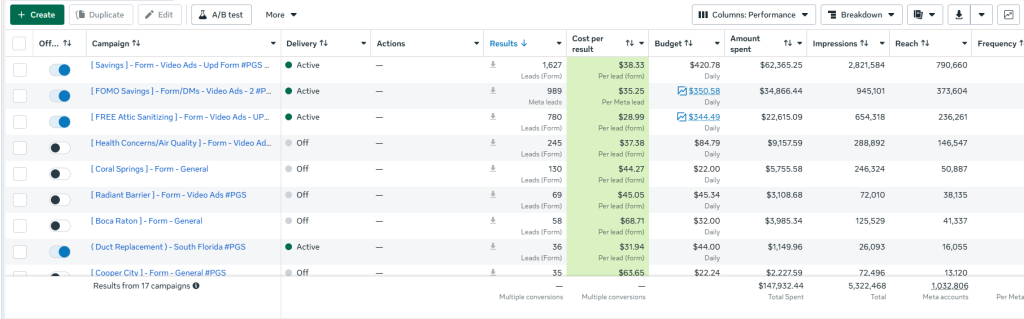
Attic Fanatics provides a useful example. Its South Florida campaigns were separated by location and angle, which allowed us to see Coral Springs producing 130 leads at a $44.27 CPL while Boca Raton was at $68.71 CPL. Instead of treating South Florida as one market, the separate campaigns showed us that individual locations were behaving differently. That cleaner data is one of the biggest advantages of a structured new market testing approach.
You can read more about our work with Attic Fanatics – South Florida in this case study: The Marketing Decisions That Led Insulation Company to $3M Revenue
3. 💰Set Your Testing Budget and Success Criteria
Before launching, decide what you are willing to spend to learn whether the market works. A paid advertising budget without predefined rules can quickly turn into an open-ended experiment. For local services, a two-to-four-week testing window is a useful starting point because leads may need time to move through the sales process. You should also establish a minimum amount of data before judging the test. We generally want at least 10–15 leads before making a serious judgment about lead quality and close rate.
Then define what success looks like. That could be a target CPL, a minimum ROAS, a booked-revenue threshold, or a combination of these metrics. The exact number will depend on the business economics, but the important part is deciding before the campaign launches. This prevents the goalposts from moving once money has been spent. If the campaign misses the threshold, you already know whether the next step is campaign optimization, a deeper diagnosis, or a pause.
4. 📈Start Small and Expand Gradually
Testing a new market does not mean launching in every possible location at once. Starting with a defined group of markets gives you enough data to learn without spreading the digital marketing budget allocation too thin. When Zumlist launched its app install campaigns, the initial focus was New York. Starting with a narrow, high-quality market made it easier to collect early data before expanding further.
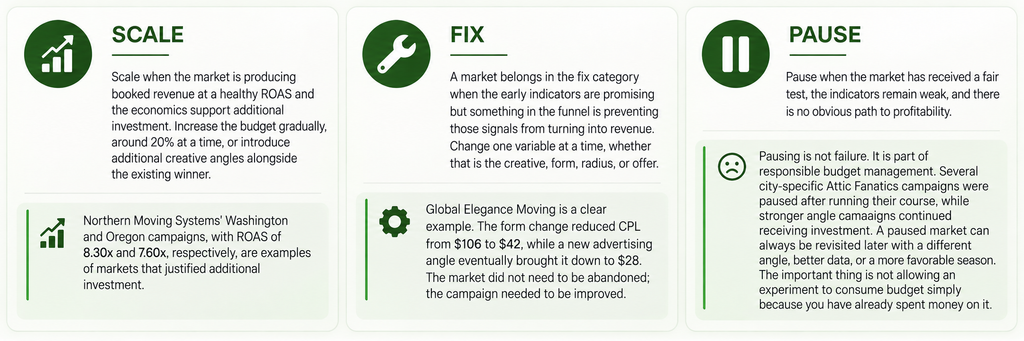
Global Elegance Moving followed a defined market approach across Georgia, New Mexico, North Carolina, and South Carolina. When the campaign initially produced a $106 CPL, the team could focus on what needed to change instead of having dozens of markets producing mixed signals. A form change reduced CPL to $42, and a new advertising angle eventually brought it down to $28. The objective is not to find the perfect market immediately. It is to identify a repeatable model in a manageable number of markets and then carry what works into the next opportunity.
5. 🛡️Protect Profitable Campaigns During Testing
New market testing should never come at the expense of campaigns that are already producing revenue. A practical starting point is to allocate roughly 10–20% of total advertising spend to experiments. This gives the new market enough room to generate meaningful data while protecting the campaigns that have already proven themselves.
Northern Moving Systems provides a useful example. When the company expanded from four states to eight, the two weakest new markets, New Jersey and Delaware, spent about $1,751 out of $17,277 in total spend. That was roughly 10% of the overall budget, while the proven markets kept their budgets intact. The principle is simple: do not pull money away from a winner just because you want to test something new. Add a controlled test budget on top, or set a firm spending cap for the experiment. That protects existing revenue while giving the business room to discover its next market.
You can read more about our work with Northern Moving Systems in this case study: __________________________
6. 📊Track the Right Performance Metrics in Order
A market test should not be judged by CPL alone. Revenue is ultimately what matters, but booked revenue often takes longer to appear. The earlier indicators help you understand what is happening while the campaign is still gathering data.
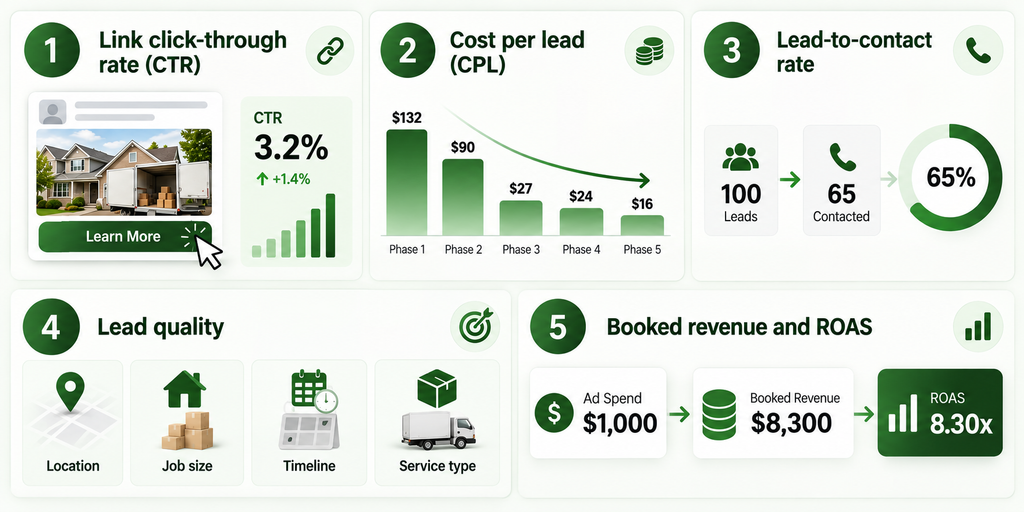
1. Link click-through rate (CTR)
CTR tells you whether the advertising message is getting a response from the audience. If people are not clicking, the creative, offer, or angle may not be relevant to that particular market.
2. Cost per lead (CPL)
CPL shows how efficiently the campaign is generating inquiries and, more importantly, how that cost is trending. One expensive day does not necessarily mean the market is failing. Look at the direction across ad sets and creative changes.
Ottawa Pro Movers is a strong example. The campaign started at $132 CPL, then moved to $90, $27, $24, and eventually $16 as successive optimizations were made. The initial number looked expensive, but the trend showed that the campaign was responding to improvements.
You can read more about our work with Ottawa Pro Movers in this case study: How Better Ad Creative Reduced Lead Costs for Ottawa Pro Movers
3. Lead-to-contact rate
A cheap lead is not useful if nobody answers the phone. The contact rate helps determine whether the campaign is bringing in people who can actually be reached.
If CPL is low but a large percentage of leads never respond, the problem may be audience fit or a form that makes it too easy for unqualified people to submit their information.
4. Lead quality
Next, look at whether those inquiries actually match the service. Location, job size, timeline, and service type can tell you whether the campaign is reaching the customers the business wants.
5. Booked revenue and ROAS
This is the final commercial test. Once leads move through the sales process, booked revenue shows whether the market can support the cost of acquisition. ROAS then puts the advertising spend into the context of the revenue it generated.
A market with a higher CPL can still be a winner if customers have high enough job values. Conversely, a low CPL can hide a poor market if those leads rarely turn into revenue.
7. 🧪Diagnose Performance Problems Before Making Changes
When a new market underperforms, the first instinct is often to change the ads. That can be the wrong move. Start by identifying where the funnel is breaking. A low CTR can indicate that the message is not connecting with the audience. A healthy CTR combined with high CPL can point toward audience size, competition, or form friction. A decent CPL with no bookings shifts attention further down the funnel toward lead quality, pricing, or follow-up.

Wailea Movers demonstrated why this distinction matters. CPL eventually climbed above $124 because the creative had stopped resonating in the small Maui market. Rather than abandoning the market, we rebuilt the angle around the specific concerns of a Maui-to-mainland move. CPL then dropped to $43. The market was not necessarily the problem; the message had become less relevant.
Northern Moving Systems showed a different pattern in New Jersey and Delaware. The campaigns had healthy CTRs of 0.97% and 0.91%, respectively, but CPL remained high and there were no bookings yet. That suggested a market-size or market-fit issue rather than an obvious creative problem. Replacing ads simply for the sake of changing something would not address the underlying issue.
Zumlist’s Android campaign was another type of test altogether. The campaign spent money without producing meaningful installs, pointing toward the platform audience rather than a straightforward creative problem. The better decision was to redirect budget toward iOS rather than endlessly tweaking the ads.
The rule is simple:
Diagnose first, change second. When you do make a change, change one meaningful variable at a time so you can understand what actually moved the result.
8. ⚖️Decide Whether to Scale, Fix, or Pause
Every market test should eventually lead to one of three decisions: scale, fix, or pause.
📚Real-World Market Testing Case Studies
The best way to understand a market testing strategy is to look at what happened when these principles were applied to real campaigns.
| Business / Market | Reported Results | Key Lesson |
| Northern Moving Systems — California | $54.60 CPL and 16.38x ROAS | Higher-value jobs can make a market profitable despite higher lead costs. |
| Attic Fanatics — Coral Springs | 130 leads at $44.27 CPL | Separate location campaigns reveal differences in market performance. |
| Attic Fanatics — Boca Raton | $68.71 CPL | Evaluate each location independently instead of blending results. |
| Ottawa Pro Movers | CPL decreased from $132 to $16 after successive optimizations | A high initial CPL does not automatically mean a market should be abandoned. |
| Global Elegance Moving | CPL decreased from $106 to $42 after a form change, then to $28 after a new advertising angle | Identify funnel friction and test changes systematically. |
| Wailea Movers | CPL rose above $124, then returned to $43 after a localized creative change | Audience-specific messaging can resolve creative fatigue. |
| Northern Moving Systems — Washington and Oregon | ROAS of 8.30x and 7.60x, respectively | Successful market tests can justify additional investment. |
| Zumlist — Android | No meaningful installs despite advertising spend | Sometimes the audience or platform is the problem, not the creative. |
These examples also show why there is no single number that automatically defines a successful market. The right interpretation depends on the business model, customer value, funnel performance, and what the campaign is trying to accomplish.
⚠️Common Market Testing Mistakes That Waste Advertising Budget
The fastest way to lose control of a new market test is to remove the rules that make the test measurable. The most common mistakes include:
- 📍 Adding new locations to existing winning campaigns. This blends the data and can disrupt campaigns that are already working.
- 💸 Setting a budget too small to generate meaningful data. A test needs enough spend and lead volume to reveal a pattern.
- ⏳ Pausing campaigns after only a few days. Early CPL can be volatile, so a short snapshot may not represent the market.
- 📊 Evaluating CPL without considering job value and booked revenue. A more expensive lead can still produce better economics.
- 🚫 Continuing to fund weak markets indefinitely. A test needs a defined point where you decide whether there is a path forward.
- 🌐 Launching language-specific campaigns without appropriate customer support. Generating leads that the business cannot properly serve creates waste downstream.
- 🛡️ Taking budget away from proven markets to fund experiments. Testing should create controlled risk, not put existing revenue at risk.
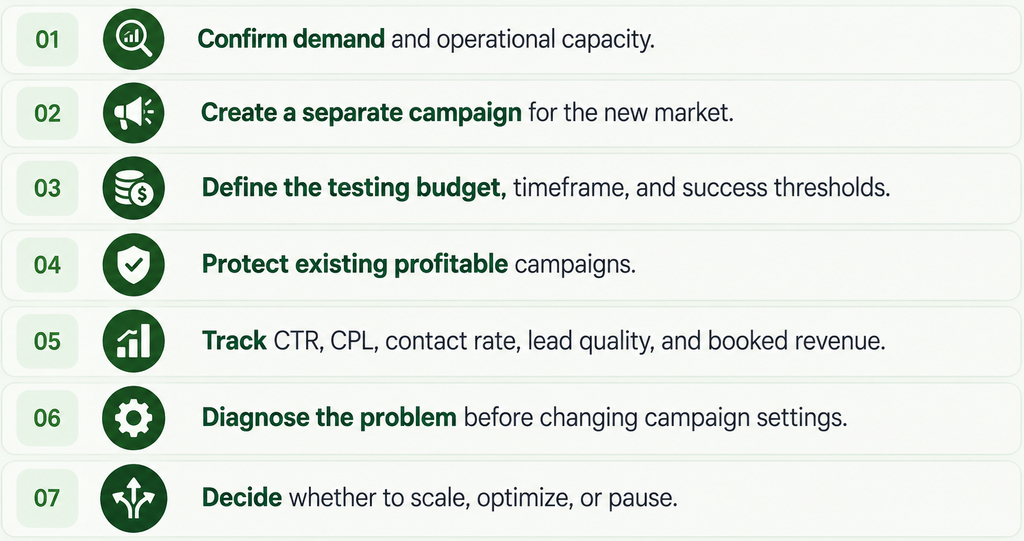
✅Final Checklist for Testing a New Market
Before launching a new market test, run through this checklist:
🚀Test With Rules, Not Hope
Learning how to test a new market is not about throwing a small budget at a new location and waiting to see what happens. It is about creating a controlled experiment where the business knows what it is testing, how much it is willing to spend, what signals matter, and what decision comes next.
A good market testing strategy protects the campaigns already making money while giving new opportunities enough room to prove themselves. Sometimes the answer is to scale. Sometimes the market needs a better message or funnel. And sometimes the smartest decision is to stop spending.
Test the market. Read the data. Fix what can be fixed. Scale what earns its place.