
🚚How One Proven Creative Angle Cut Moving Lead Costs on Maui
Every moving campaign has an expiration date. Run the same message long enough and even the right audience stops responding. In this case study, we are breaking down how HYPE Hyperion Digital used a proven creative angle to reduce cost per lead (CPL), improve campaign optimization, and revive a campaign that had run out of audience to convince.
The client was Wailea Movers, a moving and storage company based in Maui, Hawaii. The campaign focused on Maui-to-mainland moves, which are not simple local relocations. These are not moves where you pack a truck on Friday and unpack on Sunday. They involve weeks of planning, shipping logistics, and a level of trust most customers have never had to extend to a moving company before.
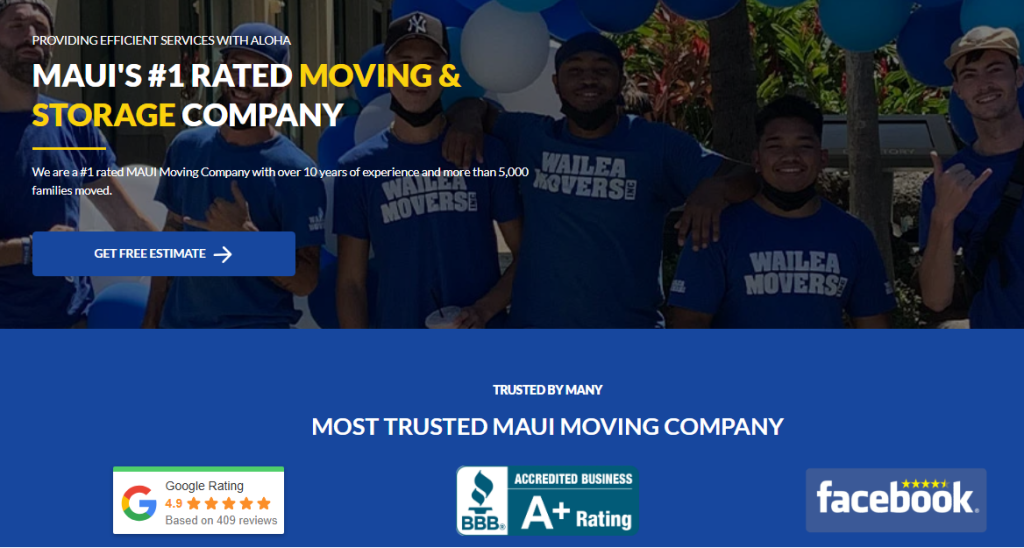
The campaign had already tested multiple creative directions, but performance was declining. CPL was moving into triple digits, some ad sets were producing zero leads, and the audience was clearly tired of the existing messages.
Instead of inventing another random ad angle, we looked at what had already worked across another moving account and rebuilt that concept for Maui’s specific market. This case study follows the market conditions, creative strategy, campaign data, and the lessons we learned from improving lead generation in one of the most limited audiences we have worked with.
🚚Why Marketing a Moving Company on Maui Is Different
Wailea Movers is not operating in a normal mainland market. They are based on a remote island with a much smaller addressable audience than markets like New York, Los Angeles, Toronto, or Miami. That changes what the ads have to do and who they need to reach.
Maui’s population also skews older, which means the audience does not behave like the typical 25-to-40 moving demographic many mainland campaigns are built around. The available market is smaller, the audience cycles through ads faster, and the cost benchmarks cannot be judged the same way as a major metro campaign.
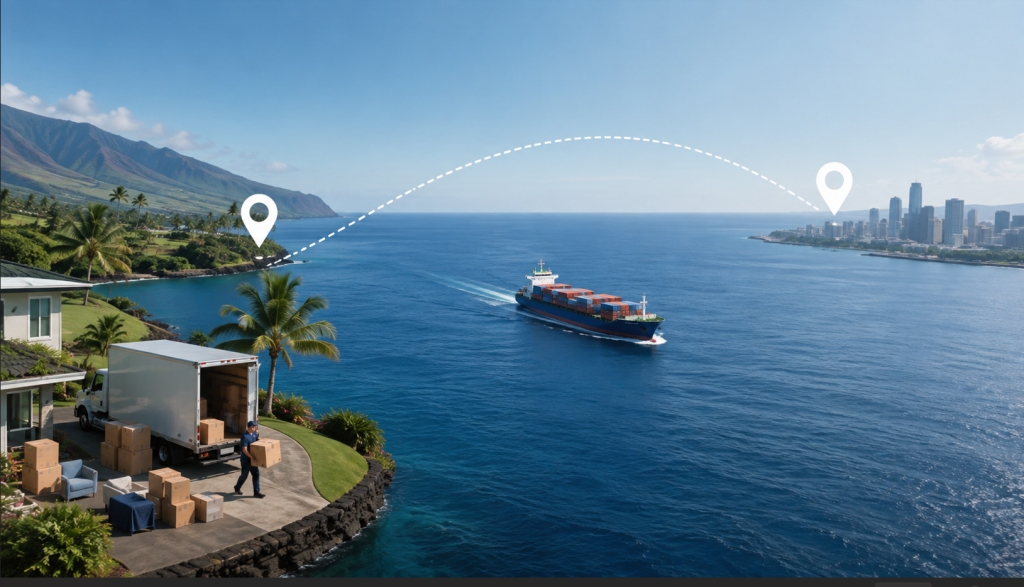
The actual move type is also more complex. Maui-to-mainland moves involve shipping, timing, coordination, distance, and a much deeper trust problem. The customer is not just moving across town. They are loading everything they own onto a barge and watching it disappear into the Pacific often without the ability to supervise or fix problems quickly if something goes wrong.
That is why a generic moving ad was never going to be enough. The campaign needed to speak to the specific emotional and logistical reality of leaving an island, not just the general stress of moving.
🌴The Reality of Advertising in a Small Market
Ad fatigue develops much faster in small geographic markets. In a large mainland city, you can rotate through broader audiences and still keep finding new pockets of people. In Maui, the same people see the same ads much sooner.
That repeated exposure slowly started hurting campaign performance. The account had already tested different angles, including aspirational messaging, fear-based messaging, FOMO, and direct-response style ads. Some worked for a while, but each one eventually became less effective as the audience became saturated.
The historical data showed the pattern clearly. CPL started climbing, then the campaign produced two consecutive ad sets with zero leads. At that point, the issue was no longer just targeting or budget. The campaign performance was telling usit had nothing left to say to this audience.
Here is what the lead generation trend looked like before the new angle took over:
| Ad Set | CPL | Leads |
| 06/09/2026 | $66.13 | 7 |
| 06/24/2026 | $92.94 | 3 |
| 07/06/2026 | — | 0 |
| 07/09/2026 | — | 0 |
| 07/10/2026 | $124.72 | 1 |
| 07/13/2026 | $105.34 | 1 |
| 07/16/2026 (Current) | $43.02 | 5 |
The audience was still there. The budget was still running. The only thing that changed was that the message no longer felt like it was about them — and on Meta, that is enough for people to keep scrolling.
🔍Looking Beyond the Account for the Right Solution
The next decision came from previous campaign experience. HYPE Hyperion Digital had already seen a timeframe-based angle work well for Cross Country Movers. That campaign used a direct callout around people planning a move soon, which helped qualify buyers before they even clicked.
The question was whether that same creative strategy could work in a completely different market.
On the surface, Cross Country Movers and Wailea Movers were not the same situation. One was built around long-distance moves across mainland markets. The other was focused on Maui-to-mainland moves from a remote island with a smaller and older audience.
But the underlying customer problem was similar: people wait too long, underestimate the move, and only realize the risk once the timeline starts getting tight.
That made the concept worth testing. We were not copying the ad. We were borrowing the framework and rebuilding it around Maui’s specific customer psychology.
⏳Why the 60-Day Angle Made Even More Sense on Maui
The 60-day angle made even more sense for Maui because island-to-mainland moves require more planning than standard relocations. You are not just booking a crew and a truck. You are dealing with scheduling, logistics, shipment timing, availability, and the reality that everything becomes harder when distance and water are involved.
That made the moving timeline feel practical, not promotional. Sixty days sounds like plenty of time until you factor in shipping schedules, crew availability, and the fact that the good slots book out fast. Then it starts to feel tight — because it is.
If someone waits too long, they can lose access to better moving dates, end up with fewer reliable options, or get pushed toward companies that hand the move off to third parties. It is often the difference between a controlled move and a stressful one.
🛡️Turning Real Customer Fears Into the Core Message
The new script focused on fears Maui customers genuinely experience. It addressed broker handoffs, crews without proper accountability, prices changing on moving day, damaged belongings, and the feeling of losing control once the shipment leaves the island.
Those concerns are not generic moving worries. They are especially intense when the customer is thousands of miles away and cannot simply drive over to check what happened. Once the belongings leave Maui, the customer has to trust that the company they hired is still in control.
That is why the script worked harder than a normal trust-based ad. It did not just say Wailea Movers was reliable. It named the nightmares the customer had already imagined. That created stronger customer trust because the message sounded like it understood the real moving experience, not just the service category.
📊Adapting a Proven Angle Instead of Copying It
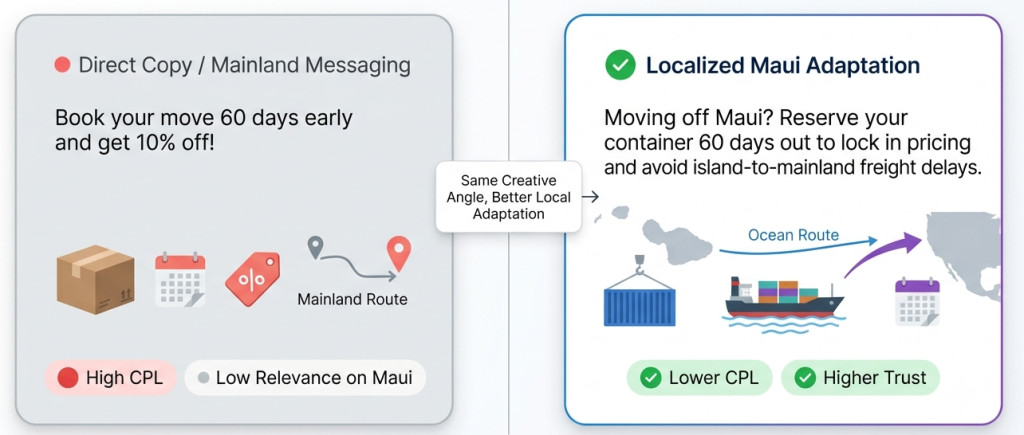
The campaign reused the underlying framework, not the exact ad. That distinction matters. A proven angle only works in a new market when the message is rebuilt around the new audience’s specific fears, logistics, and buying context.
For Wailea Movers, the framework was the timeframe-based urgency angle. But the execution had to become island-specific. The script needed to talk about Maui-to-mainland moves, not just long-distance moving in general.
This is where many campaigns get it wrong. They copy an ad that worked somewhere else and expect the same result. We adapted the concept instead. That meant keeping the proven mechanic while rewriting the message around Maui’s unique circumstances.
📊What the Campaign Data Told Us
The new creative launched after the campaign had already hit a difficult stretch. Two recent ad sets had produced zero leads, and the campaign had reached a high of $124.72 CPL. The account needed a message the audience had not already tuned out
The 60-day island-specific creative immediately changed the direction of the campaign.
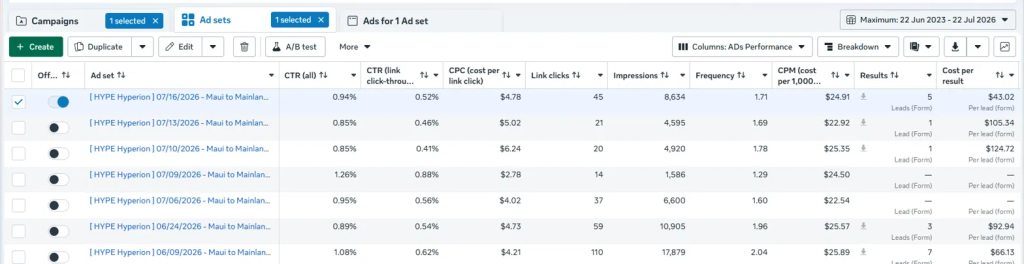
| Ad Set | CPL | Leads |
| 06/09/2026 | $66.13 | 7 |
| 06/24/2026 | $92.94 | 3 |
| 07/06/2026 | — | 0 |
| 07/09/2026 | — | 0 |
| 07/10/2026 | $124.72 | 1 |
| 07/13/2026 | $105.34 | 1 |
| 07/16/2026 (Current) | $43.02 | 5 |
The improvement was not only in CPL. It also brought lead volume back. The previous stretch showed the campaign struggling to generate meaningful response, with two ad sets producing no leads and the next two producing only one lead each.
After the new creative launched, the campaign produced 5 leads at $43.02 CPL.Five leads at $43 CPL does not sound dramatic until you remember the previous two ad sets combined for zero leads at any price. The data showed that the campaign did not need a bigger budget to come back to life. It needed a message that matched the moment the customer was actually in.
📈How One Creative Reversed Months of Ad Fatigue
The account had tested multiple creative angles over time, but small-market ad fatigue eventually caught up with them. When the same audience keeps seeing different versions of the same general message, even decent ads can lose their effect. That is especially true in a market like Maui, where the audience pool is limited.
The new script worked because it did not feel like just another moving ad. It spoke directly to the customer’s timeline, risk, and fear of losing control during an island-to-mainland move. That gave the campaign a fresh relevance signal.
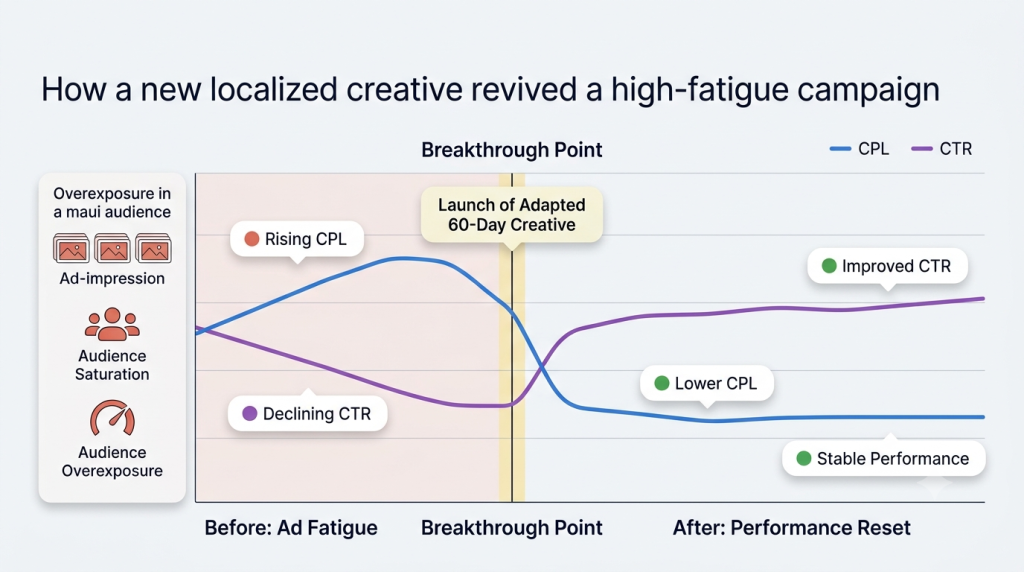
The improvement came from creative optimization, not from simply pushing more budget into the account. The learning phase needed a clearer creative signal to work with. Once the message became more specific, Meta had a better chance of finding people who were actively planning a move and likely to respond. That is how one strong creative reversed months of declining performance. It gave the campaign a sharper reason to exist in the feed again.
🌍Why This Angle Continues to Work Across Different Markets
This was the second account where a timeframe-based moving angle worked after other approaches started to plateau. It had already performed well for Cross Country Movers, and it worked again for Wailea Movers.
It was not the lines that worked. It was the idea underneath them — and that idea travelled.
The customer psychology behind both campaigns was similar: people know they need to move, but they often underestimate how early they need to plan. When the ad calls out a specific timeframe, it turns a vague future task into something that feels immediate.
- The execution changed by market.
For Cross Country Movers, the angle focused on long-distance planning and choosing the right company. - For Wailea Movers, it focused on island-to-mainland logistics, broker handoffs, lack of control, and the real risk of waiting too long in a limited market.
That is why the angle worked across both accounts. The core idea was universal, but the message was adapted to the local context.
🎯Lessons We’ll Apply from Moving Company Advertising
- The first lesson is that audience context matters more than generic creative concepts. An ad that works in a major mainland city cannot be dropped into Maui without changes. The market, audience size, moving type, and emotional stakes all change how the message should be written.
- The second lesson is that proven frameworks are valuable when they are adapted properly. You do not need to reinvent the creative strategy from scratch every time. But you also cannot copy and paste an ad from one client to another and expect the same result.
- The third lesson is that relevance remains one of the strongest performance drivers in Meta advertising. In this campaign, the budget did not save the account. A more specific message did. The ad worked because it spoke to a real planning window, a real fear, and a real moving situation the audience understood.
For marketers managing lead generation in small or highly competitive local markets, the recommendation is simple. Watch for fatigue earlier than you would in larger markets. Track which angles have worked across other accounts. Rebuild proven ideas around the local customer’s specific fears. And when performance starts to decline, do not assume the audience is gone. Sometimes the campaign only needs a message that finally sounds like it was written for that market.