How We Dropped Moving Leads Cost From $132 to $16
Advertising for movers can get expensive fast, especially when every local company is fighting for the same customers, the same high-income areas, and the same moving-season demand. In this case study, we are breaking down how HYPE Hyperion Digital took a moving campaign from a painful $132 CPL to $16.58 by changing the creative strategy, not by constantly touching the audience settings.
This campaign was especially interesting because it was launched in the Canadian market, where we do not traditionally have too many clients. That made the test more valuable because we were not just proving the strategy in a familiar market. We were seeing if it could hold up in a competitive, expensive market where we had less historical data to lean on.
The campaign was also targeting high-income areas around Ottawa and Gatineau. That matters because this type of audience is usually more expensive to reach, harder to impress, and much less likely to respond to basic “we are reliable” advertising. These people have seen plenty of moving ads before, so the creative had to do more than just look professional.
🚚 Meet Ottawa Pro Movers: The Local Moving Company from Canada
Ottawa Pro Movers is not built around being the cheapest moving company someone finds during a quick search. They are a premium local moving company in Ottawa built around higher service standards, proper equipment, trained crews, and safer moving experiences. Their positioning is not about winning on price alone. It is about giving customers a smoother, more controlled move where their belongings, timelines, and peace of mind are taken seriously.
That distinction mattered a lot when building the ad strategy. A premium mover cannot advertise like a budget mover because the buyer is not only comparing price. They are comparing trust, safety, professionalism, and the feeling that the company can actually handle the move without creating more stress. So the campaign had to sell a better experience, not just another moving quote.
Check our previous work with Ottawa Pro Movers – How HYPE Hyperion Helped a Moving Company Achieve Profitable Growth
⚠️ The Market Challenge
The moving industry has a framing problem. Most companies are saying the same thing with a different logo: “We are careful, we are reliable, we are fast, and your items are safe with us.” None of those claims are wrong, but they are so common that customers barely notice them anymore.
This creates banner blindness. When every ad sounds like the same company wearing a different logo, customers stop paying attention and Meta has very little strong creative signal to work with. That pushes moving companies into bidding wars where the only way to get more leads feels like spending more money. In reality, the bigger issue is often not the budget; it is the fact that the message is not giving the customer a fresh reason to stop, care, and convert.
🎯 The Golden Rule of Facebook Ads for Moving Companies: Creative Over Targeting
For the first test we wanted the data to actually mean something. We did not want to make the classic rookie-agency mistake: changing the audience, budget, offer, form, and creative all at once. The main campaign variables were kept steady so we could clearly see what was actually moving the numbers.
This is important because messy testing creates messy conclusions. If you change the audience, budget, offer, form, and creative at the same time, you cannot honestly say what caused the improvement. In this case, we wanted a clean read on one thing: the message. By keeping the media-buying setup stable, the creative became the real variable inside the experiment.
🌍 Going Wide: Why We Didn’t Touch the Audience Settings
The campaign ran on a 100% broad setup with age 30+ and zero interest targeting. There were no complicated stacks, no overbuilt homeowner interest groups, and no attempt to force Meta into a tiny audience box. We let the platform work with a wider pool while the creative did the filtering.
This matters because modern Meta campaigns are much better at finding buyers when you give the algorithm room to learn. Narrow targeting can sometimes look smart on paper, but it can also choke delivery and make lead costs rise. For a local moving company, especially in a premium market, the better move is often to go broad and let the ad itself call out the right people. The audience settings helped, but they were not the main reason this worked. The creative did the heavy lifting.
🎥 The Main Idea: The Video Does the Targeting For You
The first three seconds of a video ad do more targeting than most people realize. A strong hook instantly tells the right person, “This is about your problem,” while everyone else keeps scrolling. That is why the script, opening line, visual pace, and emotional angle matter so much.
For this campaign, the winning creative did not try to impress everyone. It spoke directly to people who had either experienced a stressful move before or were afraid of hiring movers and still having to manage the whole process themselves. That kind of message naturally filters for higher-intent prospects because it is specific. The right viewer feels understood, and that is when a lead form starts to feel like the next logical step instead of an interruption.
📈 Burning Cash vs. Generating Cheap Moving Leads: The 5-Week Timeline
💸 Phase 1 ($132 CPL): The Heavy Cost of “Ego-Marketing” and Narrow Hooks
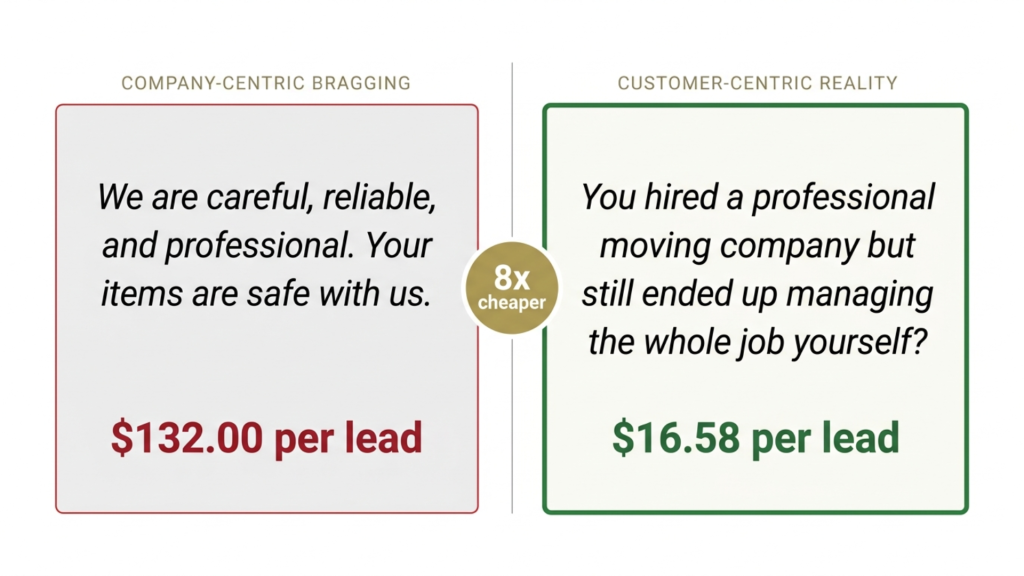
The campaign started with two videos. One focused on moving delicate antique pieces, while the other was a more standard corporate trust video built around the idea that the company was careful, reliable, and professional. Both angles were company-centric. The ads were basically saying, “Look at us,” while the customer was thinking, “But will my furniture survive the move?”
That created a weak starting point. The antique angle was too narrow, and the trust angle sounded too similar to what every other moving company already says. Instead of giving Meta one clear, emotionally sharp message to optimize around, the budget was split between two weak creative directions. The result was a painful $132 CPL.
132$ CPL Video Example:
🤝 Phase 2 ($90 CPL): The Consolidated Trust Trap
After that, we stopped splitting the budget between two weak directions and gave the Trust/VIP video a cleaner test. This helped the campaign slightly because the algorithm had a clearer path, but the message itself was still not strong enough.
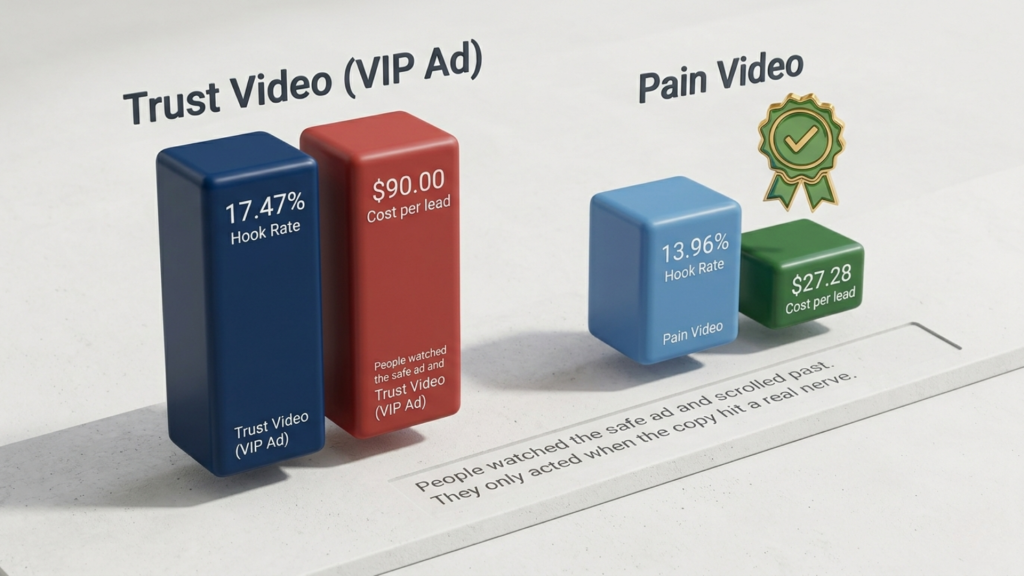
This is where the trap became obvious. The trust video was not a bad-looking ad, and it even had the strongest hook rate in the account at 17.47%. People were watching it, but watching is not the same thing as converting. The angle was still asking customers to believe the company’s claims instead of speaking to what they had actually felt during a stressful move, which kept CPL around $90.
😱 Phase 3 ($27 CPL): Flipping the Script to the Customer’s Nightmare
This was the turning point. We moved away from the “we are amazing” angle and went straight to the real pain: paying movers and still becoming the unpaid project manager of your own move. That worked because it was not about the company anymore; it was about the frustration the customer already understood.
The account reacted almost immediately. The pain-based video generated 15 leads at $27.28 CPL in its first run without needing a long optimization window. That was around 69% cheaper per lead compared to the trust angle. The difference was not that the audience suddenly changed; the message finally matched the buyer’s real concern.
🏆 Phase 4 ($24.67 CPL): The Pain-Point Elimination Bracket
After the pain angle started working, the next step was not to reinvent everything again. We looked at the two pain-point video variants and compared the performance gap between them. One version was clearly doing a better job of turning attention into leads.
24$ CPL Video Example:
So we deactivated the weaker asset and moved the budget into the stronger creative. This helped stabilize the lead flow because Meta was no longer spreading spend across a lower-performing variation. It was a simple clean-up sprint, but it mattered. Once you find the message that works, the next job is to remove anything that slows it down.
🚀 Phase 5 ($16.58 CPL): The Setup That Cracked the Meta Algorithm
The final breakthrough came when we stopped treating pain and trust like two competing ideas. Instead of choosing between pain and trust, we used them together in a simple sequence. The pain video became the main hook because it stopped the scroll and made the prospect feel understood first.
Then we brought back trust, but in the right role. A re-edited, faster-paced trust video with fresh captions worked as a secondary validator instead of the lead message. That made all the difference. Trust finally helped the campaign, not because it grabbed attention, but because it reduced doubt after the pain angle had already pulled the right people in.
🧠 Why Pain Beats Bragging in Advertising for Movers
Trust is not a bad message, but it is not a strong hook by itself. In the moving industry, trust is a baseline expectation. Customers already assume a moving company should be careful, professional, and reliable because that is the minimum requirement for being hired.
Pain works differently because it connects to memory. If someone has had a bad moving experience before, they remember the stress, the delays, the broken promises, and the feeling of having to manage everything themselves. A pain-first message validates that experience instead of asking the customer to believe another polished claim. That is why the trust angle got attention but the pain angle got action.
🔗 The Hook-and-Seal Rule
The winning formula was not “pain only” or “trust only.” It was the sequence. Pain was used as the hook because moving day is full of anxiety, pressure, and fear of things going wrong.
Once the pain message got people to stop, trust helped them feel safe enough to take the next step. That is where the VIP positioning, professionalism, equipment, and reliability became useful because the prospect was already emotionally engaged. In simple terms, pain made them stop, and trust made them feel safe enough to submit the form. When those two ideas were placed in the right order, the campaign finally had both attention and conversion power.
💰 Show Me the Money: What the Final Results Actually Look Like
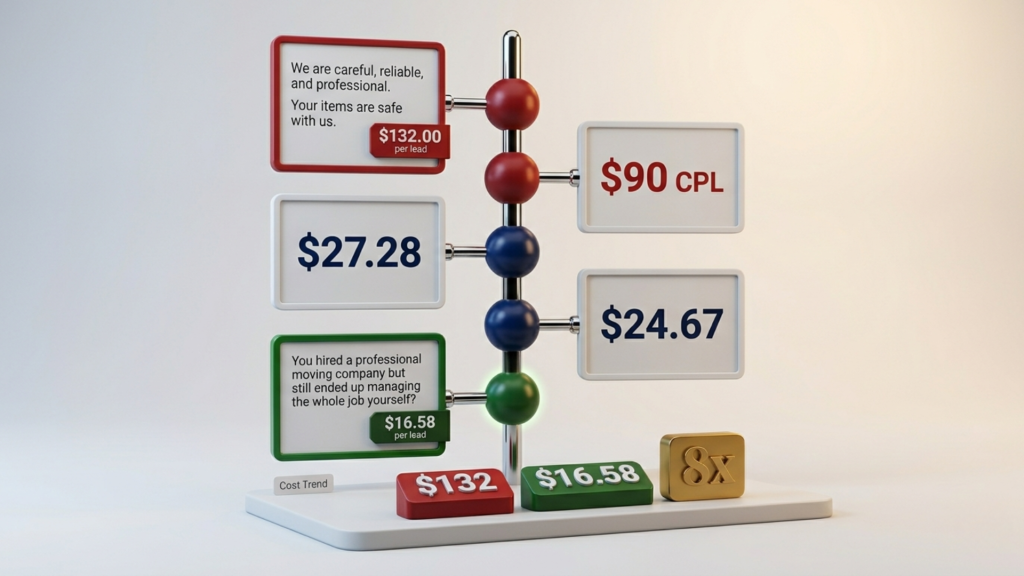
This is what the actual campaign results look like in the ad account. The campaign started with a $132 CPL when the creative was built around narrow hooks and company-first messaging. After the creative strategy was rebuilt around customer pain, cleaned up through testing, and supported with the right trust layer, the CPL dropped to $16.58.
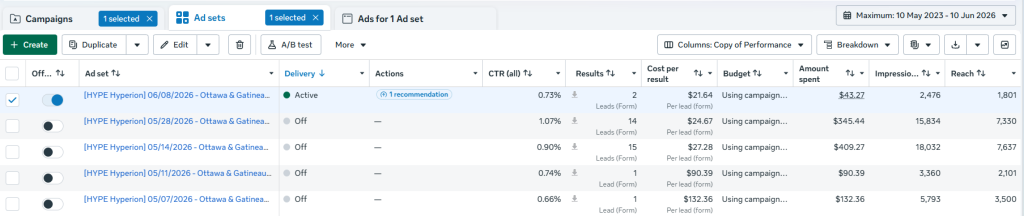
That is not a small improvement. That is roughly an 8x reduction in lead cost inside a premium Canadian market where the audience is expensive, sharp, and harder to convert. The trust angle generated only 3 leads from around $260 CAD in spend, with an average CPL near $87 CAD. The pain angle brought in 15 leads at $27.28 CPL in its first run, and the final optimized setup pushed the system even lower.
The client did not just walk away with cheaper moving leads. They walked away with a more predictable client acquisition framework. Instead of relying on generic claims, the campaign now had a clear structure: use pain to stop the right people, use trust to remove doubt, and let Meta optimize around the strongest creative signals. That is the real win here. Cheap leads are great, but a repeatable system is better. Once you know which message makes the market respond, your ad spend stops feeling like a gamble and starts becoming something you can actually build around.
A sincere thank you to Ottawa Pro Movers for trusting HYPE Hyperion Digital with this campaign and being open to testing. The best results usually come from clients who are willing to move past safe, generic messaging and let the data show what the market actually cares about. This campaign is a strong example of what happens when creative strategy, clean testing, and customer psychology work together.