📈Why More Facebook Ad Campaigns Can Beat Bigger Budgets
Every advertiser eventually reaches the same point. A Facebook Ads campaign is working, CPL is stable, and leads are coming in consistently. So the obvious move seems to be increasing the budget from $50 a day to $150 and expecting the results to triple.
Sometimes it works. But it can also go the other way. CPL starts climbing, lead quality changes, and the campaign that looked efficient at $50 a day suddenly becomes much harder to manage. More spending does not always create more profitable volume because the available audience, creative, and campaign structure all have limits.
This is where Facebook Ads scaling becomes less about simply spending more and more about choosing where the next dollar should go. At HYPE Hyperion Digital, one approach we use for local service businesses is horizontal scaling: instead of forcing one campaign to absorb all the additional budget, we create new campaigns around different angles, audiences, locations, or offers. The question is not whether vertical or horizontal scaling is always better. It is knowing when each approach makes sense.
💰Your Best Facebook Ads Campaign Is Working — So Why Not Double the Budget?
A campaign can be profitable at one spending level without being equally profitable at a much higher one. When you increase the budget, Meta does not simply show the same ad to more of the exact same high-intent people. As the campaign spends more, it has to explore additional parts of the available audience, which can change both CPL and lead quality.
That creates an important distinction between spending more and generating more profitable volume. Lead volume alone does not tell you whether a campaign is scaling well. If CPL rises while the quality of inquiries falls, the additional leads may not justify the additional spend.
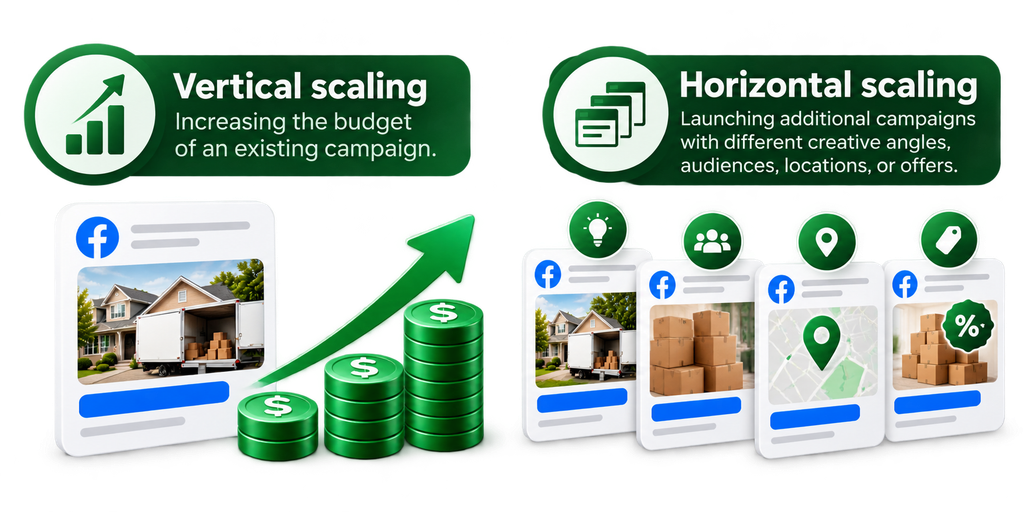
There are two main approaches to scaling Facebook ad campaigns:
- Vertical scaling: Increasing the budget of an existing campaign.
- Horizontal scaling: Launching additional campaigns with different creative angles, audiences, locations, or offers.
Both approaches can work. The better choice depends on the size of the audience, how the current campaign is performing, how much room it has to grow, and where the account is in its growth stage.
Key insight from HYPE Hyperion Digital: Scaling is not about choosing one method every time. It is about reading the account, understanding the market, and deciding whether the next opportunity calls for more budget behind what is already working or a new campaign that can open another path to growth.
⚖️Vertical vs. Horizontal Scaling — Two Ways to Grow Without Guesswork
Vertical scaling is the simpler approach. You take a campaign that is already working and increase its budget to try to generate more volume from the same setup. When the audience is large enough and the campaign still has room to find qualified prospects, this can be an effective way to grow.
Horizontal scaling takes a different route. Instead of asking one campaign to do more, you create another campaign with a distinct purpose. That might mean a different customer motivation, a new creative concept, another location, or a different offer. The original campaign continues running while the new campaign develops its own performance history. Pasted markdown (2)
| Factor | Vertical Scaling | Horizontal Scaling |
| Main approach | Increase an existing campaign’s budget | Launch additional campaigns |
| Primary objective | Generate more volume from the current setup | Reach additional audience segments or opportunities |
| Main risk | Higher CPL or declining lead quality as spend grows | More campaigns to manage and evaluate |
| Best suited for | Campaigns with room to absorb additional spend | Accounts with new angles, locations, or audiences to test |
Horizontal scaling does not mean duplicating the same campaign several times and hoping the algorithm finds something new. Each campaign should have a reason to exist. The goal is to create another entry point into the market, not simply another copy of the campaign that is already running.
🚧 What Happens When You Push One Campaign Too Far?
Every Facebook ad campaign has a limit to how much it can scale efficiently. As spending increases, Meta may need to reach beyond the audience segments most likely to convert. This can lead to higher acquisition costs and fewer qualified leads per dollar spent.
Audience size plays an important role. A campaign targeting a large metropolitan area, such as Houston, generally has more room to expand than one targeting a smaller market like Maui. However, a larger population does not guarantee unlimited growth. Even in major cities, increasing a campaign’s budget from $50 to $500 per day can reduce efficiency if the most responsive prospects have already been reached.
Ad frequency is another important metric. When the same people repeatedly see the same creative, additional spending may generate more impressions without producing enough new leads. Over time, this can lead to Facebook Ads creative fatigue, where engagement declines and acquisition costs rise.
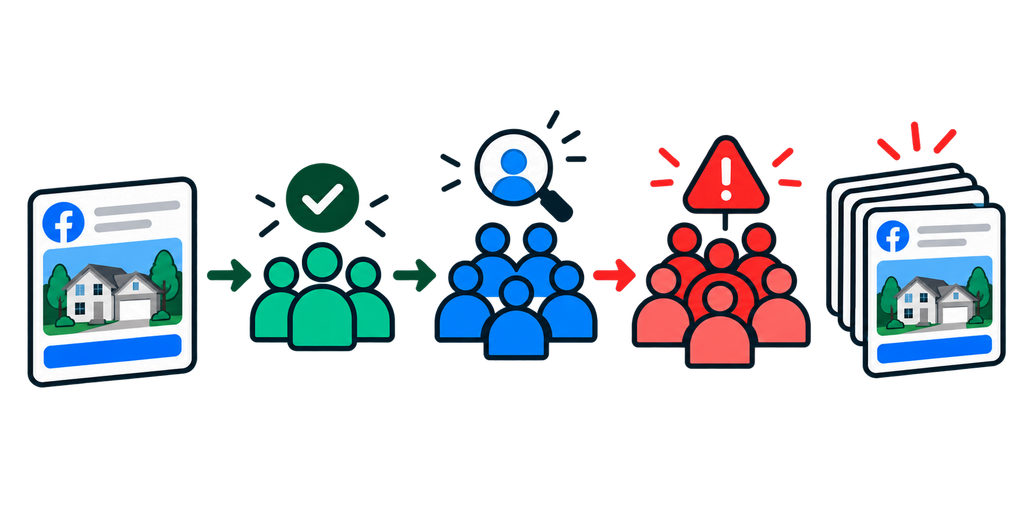
To maintain efficiency, increase budgets gradually and monitor performance after each adjustment. Raising the budget by approximately 20–25% at a time can be a useful starting point, although the appropriate pace depends on the campaign, audience size, and account performance.
The Key Takeaway: A campaign reaching its current scaling limit does not necessarily mean the market has no further potential. It may be time to introduce new creative angles, test additional audiences, or launch separate campaigns to reach new groups of qualified prospects.
🏠Six Campaigns, Six Reasons to Buy — The Attic Fanatics Case Study
Attic Fanatics in South Florida is a strong example of what horizontal scaling can look like in practice. Instead of asking one campaign to reach every homeowner with one message, HYPE Hyperion Digital ran multiple campaigns built around different customer motivations.
The reported campaign results were:
| Campaign Angle | Leads | Cost per Lead |
| Savings angle | 1,627 | $38.32 |
| FOMO savings | 988 | $35.27 |
| Free attic sanitizing | 780 | $28.97 |
| Spanish speakers | 830 | $25.96 |
| Blow-in only | 721 | $28.79 |
| Broad campaign | 949 | $36.08 |
Each campaign gave the same broad service a different reason to convert. The savings angle spoke to homeowners concerned about high energy bills. The FOMO savings campaign framed the savings proposition differently. The free attic sanitizing campaign focused on attic cleanliness and related concerns, while the Spanish campaign reached a Spanish-speaking audience through language-specific advertising.
The blow-in campaign focused on a specific insulation service, while the broad campaign provided a wider entry point into the market. These were not six versions of exactly the same message. They represented different reasons a potential customer might decide to take action.
The Attic Fanatics partnership generated close to $3 million in revenue, with 10–12 campaigns running simultaneously across different angles, locations, and audience segments. The six campaigns shown above were part of that broader structure and should not be interpreted as individually responsible for a proportional share of the total revenue.
Check our detailed work with Attic Fanatics: The Marketing Decisions That Led Insulation Company to $3M Revenue
Key insight: One service can appeal to customers for completely different reasons. Different campaign angles can create additional opportunities without requiring a new service or geographic market.
🎯When Spending More on One Campaign Actually Makes Sense
Horizontal scaling is not automatically the answer. There are situations where vertical scaling makes more sense, particularly when the existing campaign has enough audience depth to support additional spending. The first is audience size. A national campaign or large metro market with millions of potential customers may be able to absorb more budget without frequency rising too quickly. The second is the learning period. Sometimes a campaign simply needs additional spend to collect enough data, and creating another campaign would divide that learning across multiple setups.
The third situation is when the creative is consistently attracting high-intent prospects and the available audience still has room to grow. In that case, putting more budget behind the existing campaign may be the cleaner approach. P
This is where vertical scaling vs horizontal scaling should be treated as a decision rather than a fixed rule. If more spend can still reach qualified prospects efficiently, vertical scaling can work. If additional spending mainly pushes the campaign into weaker audience segments, another campaign may provide a better route to growth.
Key insight: Do not launch more campaigns simply because horizontal scaling sounds safer. Choose the approach based on actual performance signals and available audience capacity.
🗺️Four Markets, Four Budgets — How Northern Moving Systems Scaled Across Locations
For businesses operating across several cities or states, horizontal scaling can take a geographic form. Instead of putting every location into one campaign, each market can have its own campaign, budget, and performance history. Northern Moving Systems used this approach across Texas, Georgia, North Carolina and South Carolina, and California. Each market had its own daily budget:
| Market | Daily Budget | CPL |
| Texas | $80 | $27.27 |
| Georgia | $60 | $28.53 |
| North Carolina + South Carolina | $132 | $32.88 |
| California | $60 | $34.25 |
The benefit was visibility. Each market produced its own cost per lead (CPL), making it easier to see where acquisition costs were lower or higher and decide where further testing might be worthwhile.
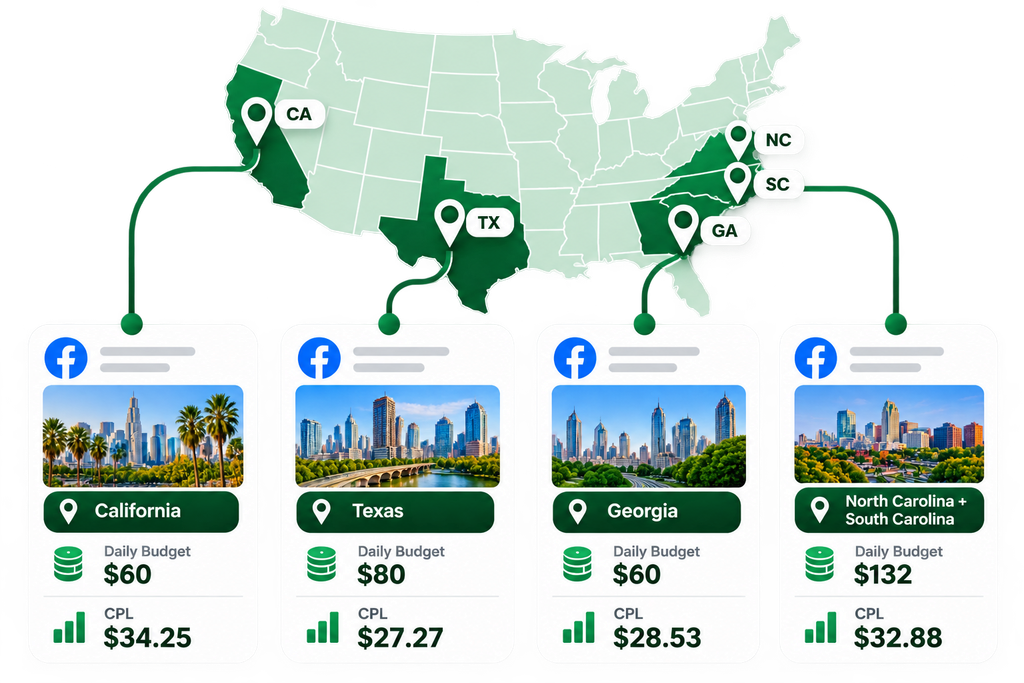
For example, Texas was at $27.27 CPL while California was at $34.25. If all four markets had been combined into one campaign, those differences would have been much harder to isolate. Separate multi-location Facebook Ads campaigns created cleaner data for market-level decisions. That does not mean Texas was automatically more profitable simply because it had the lowest CPL. The reported figures here provide budget and CPL data, not comparable revenue or ROAS for each market. The value of the structure was the clarity it created for Facebook Ads budget optimization.
Check our detailed work with Northern Moving Systems:How HYPE Hyperion Digital Scaled Facebook Ads for Movers Across 8 States
Key insight: Combining all markets into one campaign could have obscured differences in efficiency and made budget allocation decisions less precise.
🧪One City, Two Campaigns — How EZ Home Solutions Found More Leads
Horizontal scaling does not require entering a new city. Sometimes the opportunity is sitting inside the same market but needs a different creative entry point.
EZ Home Solutions in Houston provides an example. Its original image-based campaign settled at around $41 CPL. Instead of replacing that campaign, HYPE Hyperion Digital introduced a separate campaign built around a revived November–December best-performing creative. The new campaign ran alongside the original and generated 11 leads at $36.81 CPL in its first post-optimization run. The important part was the structure: the existing campaign was not sacrificed to make room for the new test.
This is a useful example of Meta Ads campaign optimization through an additional creative route. The new campaign gave the same Houston market another way to respond without assuming that the original campaign had to be shut down.
Key insight: Horizontal scaling can involve a new advertising concept, not just a new location or audience. The additional campaign’s initial CPL should not be treated as a permanent performance benchmark. It was an early result from the post-optimization run, not a guarantee that the campaign would remain below the original campaign over time.
🔁The Hidden Cost of Running the Same Ad Too Often
One of the biggest arguments for multiple campaigns is creative fatigue management. A campaign spending $500 a day can expose its audience to the same creative much faster than a campaign spending $50 a day. As frequency rises, people become increasingly familiar with the message. Eventually, responsiveness can fall and CPL can start moving in the wrong direction.
This is why Facebook Ads frequency deserves attention when evaluating scaling decisions. A rising frequency does not automatically mean a campaign is failing, but when it appears alongside worsening CPL, it can signal that the current audience and creative combination is reaching its practical limit.
Introducing another campaign with a genuinely different angle can create another opportunity to connect with the audience. The goal is not to pretend that separate campaigns eliminate overlap. They do not. The goal is to diversify the advertising approach rather than relying on one creative route indefinitely.
Key insight: Creative fatigue should be evaluated using campaign data, not assumed solely from budget size. Multiple campaigns do not automatically eliminate audience overlap or guarantee lower frequency.
⚠️Three Warning Signs Your Facebook Ads Campaign Has Hit a Ceiling
There are several signals that can indicate it is time to consider a different scaling approach. None should be treated as an automatic rule, but together they can help identify when the current setup needs another entry point.
1. 📉CPL has stopped improving.
If the campaign has gone through reasonable optimization and CPL has reached a stable floor, simply adding more budget may not make the acquisition cost better. Stable CPL alone is not enough to justify horizontal scaling, though. Volume, lead quality, and downstream conversion still need to be considered.
2. 👀Ad frequency is rising.
Increasing frequency means the audience is seeing the advertising more often. If frequency continues climbing, the available audience may have limited room for additional reach within the current structure.
3. 📊More spending is not producing proportionate growth.
If the budget increases substantially but qualified lead volume does not grow at the same rate, the campaign may be experiencing diminishing returns. This is particularly important in smaller geographic markets where the available audience is finite.
Key insight from HYPE Hyperion Digital: When CPL has stopped improving and frequency is rising at the same time, consider testing a new campaign angle rather than simply pushing more budget into the existing setup. These are diagnostic signals, not automatic instructions to launch another campaign. The full funnel still needs to be reviewed before deciding what to change.
🛑The Facebook Ads Scaling Mistakes That Quietly Drain Your Budget
Scaling problems often come from treating every campaign as if it has unlimited room to grow. Common mistakes include:
- 📈 Increasing budgets too aggressively without monitoring results. A large jump can push a campaign into less efficient audience segments and make it harder to understand what changed.
- 🚧 Expecting one campaign to deliver unlimited growth. Every audience has practical limits, especially in local markets.
- 🔄 Replacing profitable campaigns unnecessarily. If a campaign is still producing efficiently, there may be no reason to disrupt it simply because you want more volume.
- 📉 Ignoring changes in CPL and lead quality. More leads are not necessarily better if acquisition costs rise and the quality of inquiries falls.
- 🎨 Relying on one creative angle for too long. A single message can become less effective as the audience sees it repeatedly.
- 📍 Combining locations in ways that obscure market-level performance. Blended results make it harder to see where budget is actually working.
- 🧪 Launching duplicate campaigns without a distinct testing hypothesis. Multiple campaigns should have different purposes rather than simply competing versions of the same setup.
- 🎯 Judging success by lead volume without evaluating business outcomes. Lead volume needs to be considered alongside quality, conversions, and the economics of the business.
These mistakes all point to the same problem: scaling without a clear reason for where the additional budget is going. A stronger paid advertising strategy treats every new campaign or budget increase as a deliberate decision rather than an automatic next step.
🚀Scale the Campaign — or Open a New Door?
The decision becomes much simpler when you look at what the existing campaign is telling you.
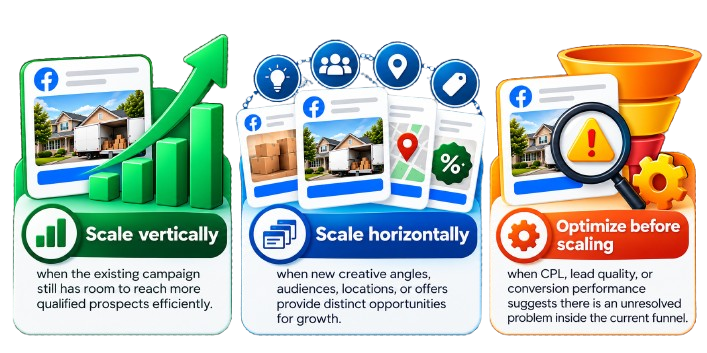
The experience across Attic Fanatics, Northern Moving Systems, and EZ Home Solutions shows why Facebook Ads scaling should not be reduced to one tactic. Attic Fanatics created additional volume by approaching the same market through different angles. Northern Moving Systems used separate location campaigns to keep market-level performance visible. EZ Home Solutions added a new creative route within the same city without replacing its original campaign.
The real question when performance plateaus is not always “How much more money should we put into this campaign?” Sometimes the better question is “Which new door can we open for the same audience?”