How We Built a Nearly $3M Lead Generation System for an Insulation Company
Facebook advertising for insulation company growth is not about launching one good campaign and hoping it carries the business forever. It works best when the ads, lead forms, automation, sales follow-up, and long-term marketing strategy all work together toward revenue.
That is exactly what we built for Attic Fanatics, a South Florida insulation company serving Miami-Dade, Broward, and Palm Beach. They specialize in attic insulation, blow-in insulation, spray foam insulation, insulation removal, and attic sanitizing.
This case study is not about one viral creative or one lucky Facebook campaign. It is about how HYPE Hyperion Digital helped build a full customer acquisition system that generated close to $3 million in revenue. From December 2024 onward, every part of the process was tested, improved, and connected: campaign angles, lead forms, automation, sales follow-up, SEO, content, and tracking.
The result was a system that consistently produced high-volume lead flow, strong revenue months, and 8x to 12x ROAS across the best-performing campaigns.
We Didn’t Launch Facebook Campaigns. We Built a Revenue Engine.
When Attic Fanatics came to HYPE Hyperion Digital, the account was starting from the ground up. There were no winning creatives, no lead flow to build on, no proven messaging, and no infrastructure to scale from. So the goal was never just “run Facebook Ads.”
The goal was to build a revenue engine.
That system eventually included Facebook Ads, Meta Lead Forms, GHL Automation, a sales pipeline, a speed-to-lead process, SEO, content, and link building. Each piece had a specific role. Facebook created immediate demand, the form qualified the lead, automation pushed the lead into the pipeline, the sales system helped close the job, and SEO built long-term visibility in the background.
This is why the growth was not dependent on one campaign. If one angle slowed down, another could pick up. If a creative fatigued, new variations were ready to test. If paid ads created immediate lead flow, SEO was building a second channel for future qualified traffic.
Why South Florida Homeowners Buy Insulation for Different Reasons
South Florida is a very specific market. There is no off-season for heat in South Florida. The AC runs in February the same way it runs in August.
Homeowners in Miami-Dade, Broward, and Palm Beach run their AC almost all year. Summer temperatures regularly push into the high 90s, and humidity can make the home feel even hotter. Energy bills are not a background concern.. They are a monthly conversation in almost every household.
That changed the entire strategy. We did not need to convince people that their home was uncomfortable or their electric bill was high. They already knew that. The job was to show them that their attic could be the reason behind the problem and that insulation was a practical solution.
Instead of positioning insulation as a technical upgrade, the campaigns led with outcomes people already cared about: lower bills, cooler rooms, cleaner air, fewer attic issues, and better home comfort.
One Offer Was Never Going to Reach Every Homeowner
A single offer was never going to scale this account. Different homeowners were motivated by different things, so the campaign structure had to reflect that.
Some people cared most about saving money. Some cared about air quality. Some were worried about mold, bacteria, and attic contamination. Some responded to tax credits. Some needed Spanish-language messaging. Others only took action when seasonal urgency made the problem feel immediate.
That is why HYPE Hyperion Digital built multiple angles at the same time.
| Campaign Angle | Main Emotion | Main Offer |
| Energy Savings | Save money | Lower electric bills |
| Indoor Air Quality | Health | Cleaner air |
| Mold & Sanitizing | Fear | Remove bacteria |
| Tax Credit | Financial incentive | Government savings |
| Spanish Campaigns | Localization | Native communication |
| Seasonal Campaigns | Urgency | Prepare before summer |
This gave the account more room to scale. Instead of forcing every homeowner into the same message, each campaign spoke to a different reason someone might finally book an insulation estimate.
Saving Money Drove the Highest Lead Volume
The savings angle consistently produced the most leads, and the reason is simple: a $400 electric bill in July is not a concept. It is a screenshot someone texts their spouse. Homeowners feel that pain every month.
The messaging did not lead with insulation products, materials, or technical details. It led with the financial frustration people already understood: your attic may be the reason your AC bill is so high. That made the offer easier to connect with because the homeowner did not need to care about insulation first. They only needed to care about paying less to keep the house cool.
- Example ad copy that converted:
- “South Florida homeowners — your AC’s working overtime. And deep down, you know your attic’s the real reason. Here’s the truth: You don’t need a $10K attic remodel to stay cool. In most homes, a simple blow-in insulation upgrade is all it takes. The problem? Too many companies scare you with big words and upsell what you don’t need. At Attic Fanatics, we keep it real: Honest attic assessment. No upsells, no pressure. Up to 30% lower energy bills. Safer air, cooler home. Now: Get $250 OFF your insulation project. Plus — qualify for up to 30% back via Federal Tax Credit.”
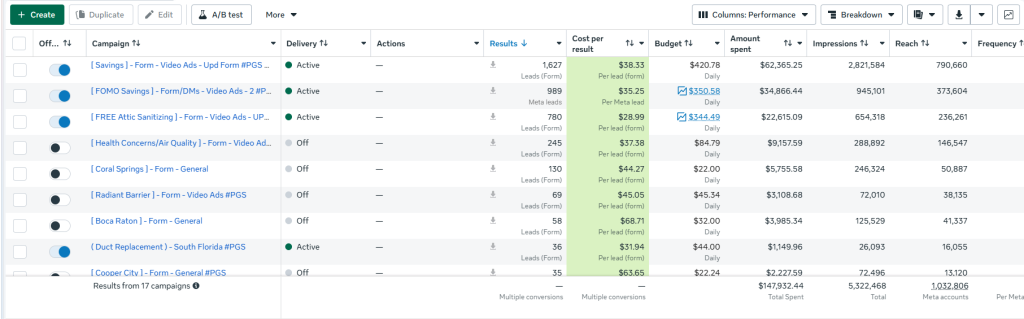
One savings campaign generated 1,627 leads at a $38.32 CPL with $62,342 in spend. Another FOMO savings campaign generated 988 leads at a $35.27 CPL with $34,848 in spend. Together, the savings angle produced more than 2,600 leads and remained one of the most consistent lead volume drivers in the account.
Health Messaging Reached a Different Buyer
The health and air quality campaigns reached homeowners who were not mainly focused on saving money. These buyers cared about what their family was breathing inside the home. The messaging connected attic sanitizing, mold prevention, bacteria, allergens, and poor insulation to the air quality inside the house.
This angle expanded the audience beyond traditional energy-efficiency messaging. It worked especially well for families with young children, elderly family members, or people dealing with recurring allergy-like symptoms. For these homeowners, the attic was not just an energy problem. It was a hidden part of the home that could affect comfort, cleanliness, and health.
The health and air quality campaign generated 245 leads at a $37.38 CPL with $9,157 in spend. It was not the highest-volume angle, but people who respond to health messaging are usually already living with the problem, which is why the intent to book was higher.
Tax Credits, Spanish Ads, and Seasonal Urgency Expanded the Market
Additional campaign angles helped unlock audiences that standard insulation advertising often misses. The tax credit angle reduced price resistance by showing homeowners that they may qualify to get up to 30% back through federal tax credits. Instead of defending the cost of the project, the ad made the project feel like a smarter financial decision.
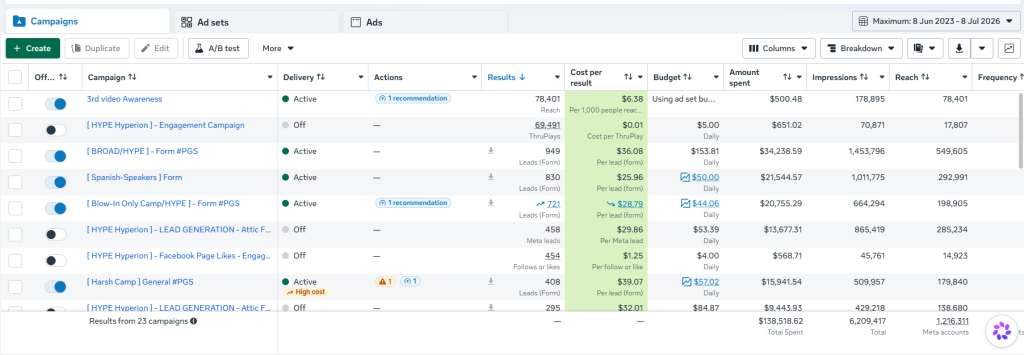
Spanish-language campaigns opened another important audience in South Florida. The best-performing angles were adapted into Spanish, including savings, health, and tax credit messaging. One Spanish Speakers campaign generated 830 leads at a $25.96 CPL with $21,543 in spend, making Spanish the single most cost-efficient audience segment across the entire account.
Seasonal urgency added another layer. The FOMO and urgency angle reminded homeowners that energy costs were rising, summer heat was not slowing down, and other local homeowners were already taking action. Urgency that is tied to a real, ongoing problem does not need to push. The homeowner already feels it every time they walk into a hot room.
Every Question Had to Earn Its Place
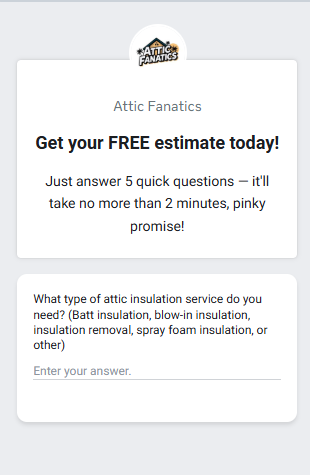
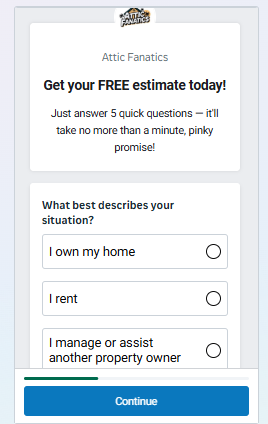
The Meta lead form was intentionally designed to qualify homeowners without creating unnecessary friction. That balance mattered. If the form asked too many questions, good prospects could drop off before submitting. If the form asked too few questions, the sales team would waste time calling people who were not a fit.
So every question had to earn its place. The first question was an ownership qualifier: “What best describes your situation?”
The options included:
- 🏠 I own my home
- 🔑 I rent
- 🏢 I manage or assist another property owner
This helped filter the lead quality immediately. Renters could be removed because they usually cannot authorize an insulation project. Property managers could be placed into a separate follow-up category because they may represent more than one property.
The second question focused on service intent:
“What type of attic insulation service do you need?”
The form included options such as batt insulation, blow-in insulation, insulation removal, spray foam insulation, or other. This gave the sales team useful context before the first call. Instead of starting every conversation from zero, they already knew what type of service the homeowner was interested in. That helped reduce wasted time and made the first sales conversation more specific. The form stayed simple for the homeowner, but it did real qualification work in the background. That helped improve both conversion rates and lead quality.
Most Thank-You Pages End the Conversation. Ours Started Another One.
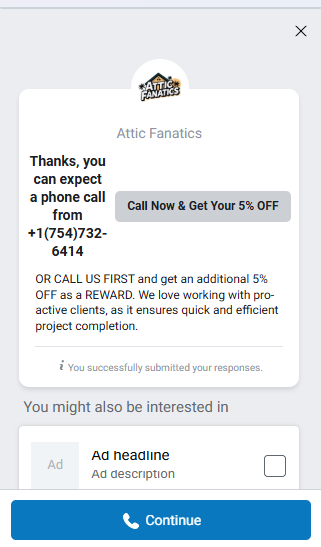
Most thank-you pages do almost nothing. A homeowner submits the form, sees a basic confirmation message, and leaves. We turned the confirmation page into an active part of the conversion funnel. After submitting the form, homeowners were encouraged to call immediately to receive an additional 5% discount. The message gave proactive prospects a reason to take the next step right away instead of waiting for a callback.
The confirmation page said:
“Thanks, you can expect a phone call from us shortly OR CALL US FIRST and get an additional 5% OFF as a REWARD. We love working with proactive clients.”
That small change created another opportunity to engage highly motivated homeowners. Inbound calls are often one of the highest-intent lead types in home service campaigns because the prospect is choosing to start the conversation. This optimization generated additional phone calls without increasing advertising costs.
Speed to Lead Turned Marketing Into Revenue
Generating Facebook leads was only the beginning of the acquisition process. If those leads sat too long without a response, the opportunity could cool down quickly. Homeowners are usually comparing multiple companies, so the business that responds faster often gets the better chance to book the job.
Every lead was automatically routed into the GHL pipeline. The sales team received the lead’s name, contact information, and form answers within seconds. There was no manual checking, no delay, and no lead sitting unnoticed for hours.
HYPE Hyperion Digital also helped guide the client through the HYPE Sales System.
That included:
- 📞 how to open the first call
- 💬 how to handle common objections
- 📲 how to follow up when someone did not answer
- 📈 how to identify upsell opportunities during the project conversation
This mattered because leads without a sales process are just expensive data. The ads created the demand, but the sales system helped turn that demand into booked projects. Speed to lead, structured follow-up, objection handling, and upsell opportunities became major drivers of revenue.
Every Campaign Became the Starting Point for the Next One
Long-term growth was not driven by one successful advertisement. It came from continuous optimization. Over time, more than 23 Facebook campaigns were launched, tested, and iterated across the account. Hundreds of creative variations and videos were tested across different messages, offers, and audience segments.
Every campaign produced usable data. Savings campaigns showed which bill-related messages created the most volume. Health campaigns showed how air quality and family safety changed buying motivation. Tax credit campaigns showed how financial incentives reduced price resistance. Spanish campaigns proved that language adaptation could unlock a more efficient audience.
Testing became a permanent growth strategy, not a one-time task. The account kept improving because every result fed into the next decision. We cut what did not work, kept what did, and continued building new angles based on what the market responded to.
While Facebook Generated Leads, SEO Built Long-Term Growth
Facebook Ads generated immediate lead flow, but HYPE Hyperion Digital also developed SEO alongside paid advertising.
That was important because paid campaigns create demand quickly, but SEO builds a more sustainable source of qualified traffic over time. A business that only runs paid ads does not have a marketing strategy. It has a subscription. Turn off the spend and the leads stop the same day. SEO gives the company another way to capture homeowners who are already searching for insulation services.
When the project began, the website had very limited organic visibility. There were also technical issues that made it harder for Google to properly discover, crawl, and index important pages.
So the SEO strategy started with the foundation. Before publishing large amounts of content, the website needed to be easier for search engines to understand. The goal was to create a structure that could
Rebuilding the Website Before Scaling Organic Traffic
The first SEO stage focused on fixing the website’s technical foundation.
This had to happen before scaling content. Publishing more articles would not have solved the main issue if Google could not properly crawl and understand the important service pages. So navigation, internal linking, page hierarchy, and HTML structure were reorganized first.
The goal was to make the most important pages easier to find, easier to crawl, and easier to index. Within the first month, nearly every important service page was indexed. That created the foundation for long-term organic growth. Once the technical structure was stronger, the website had a better chance of ranking for insulation-related searches in the South Florida market.
Technical SEO Improved Crawling and Indexation
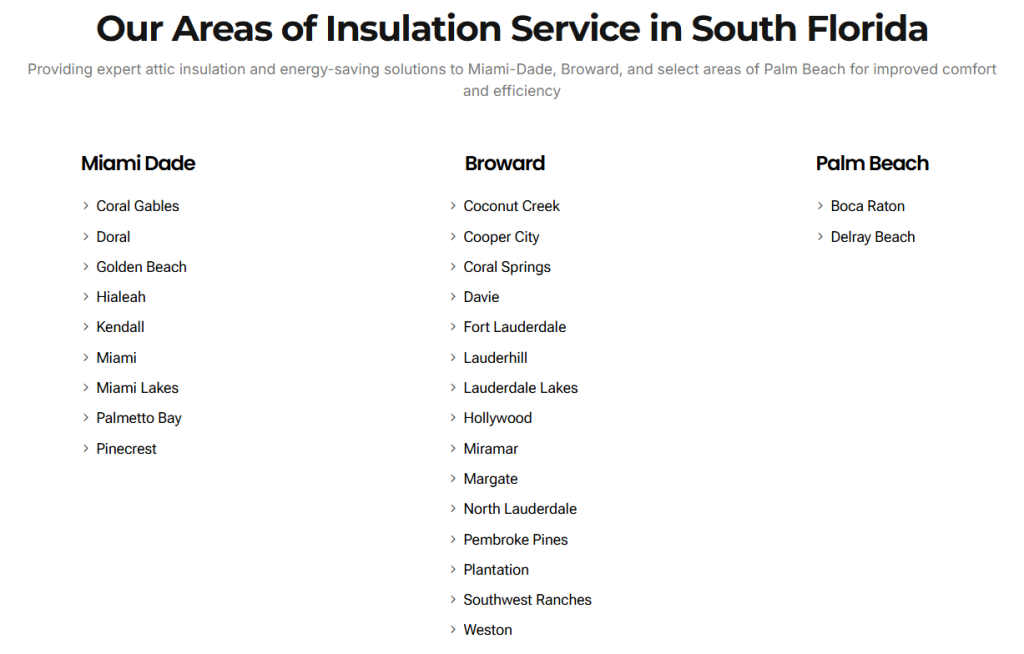
The website’s header and footer navigation were completely reorganized to prioritize the company’s highest-value service pages. Instead of relying on a generic menu structure, we grouped related services logically, reduced unnecessary navigation elements, and ensured that every core service could be reached within just a few clicks. This improved both user experience and Google’s ability to crawl and distribute authority across the site’s most important pages.
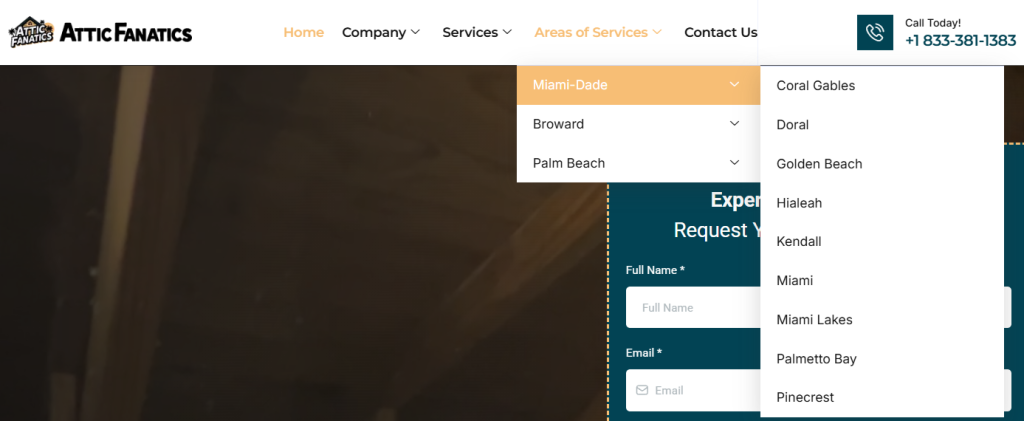
We also rebuilt the internal linking strategy throughout the website. Service pages, location pages, blog articles, and supporting resources were interconnected using contextual anchor text, creating clear topical relationships between pages. This strengthened the site’s overall architecture, helped search engines better understand content relevance, and encouraged visitors to explore additional services instead of leaving after viewing a single page.
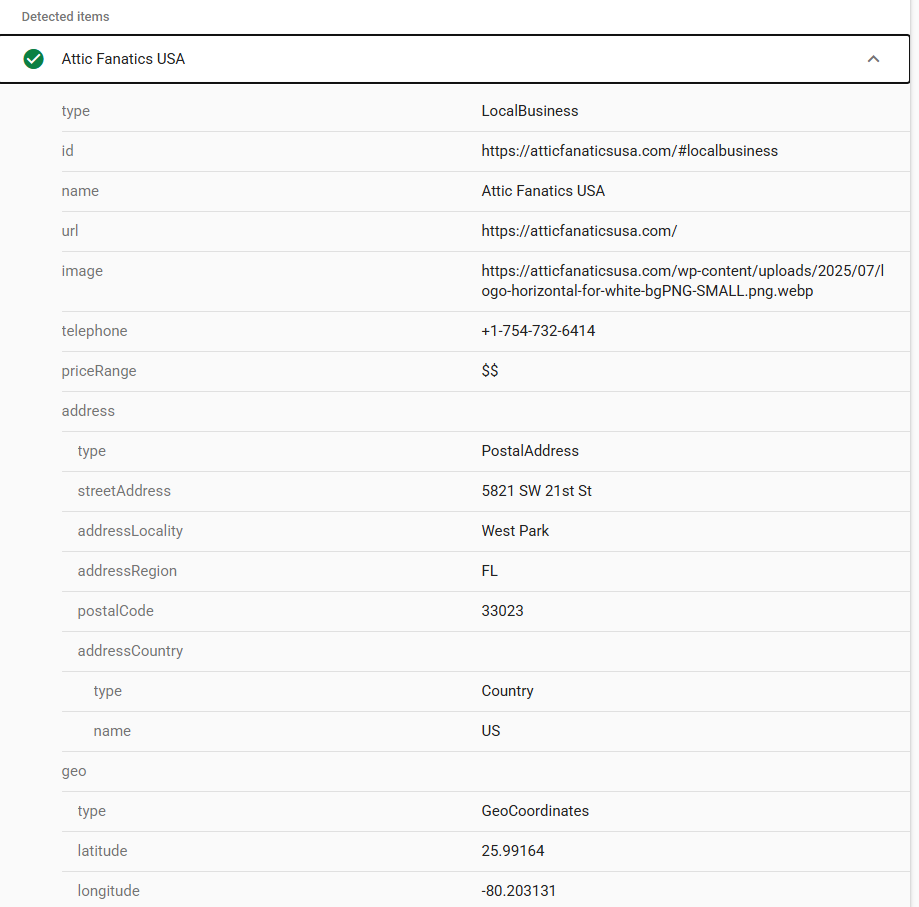
To reinforce the site’s local SEO signals, we implemented comprehensive Local Business Schema across key pages. Structured data was added to provide search engines with consistent information about the business, including its services, location, contact details, service area, and organizational relationships. This improved content interpretation, strengthened local relevance, and supported better indexing of important service pages.
Service pages were connected through a stronger internal linking strategy. This helped distribute authority across the website and made it easier for Google’s crawler to move between key pages. Instead of leaving important pages isolated, the site structure gave each service a clearer place inside the broader website.
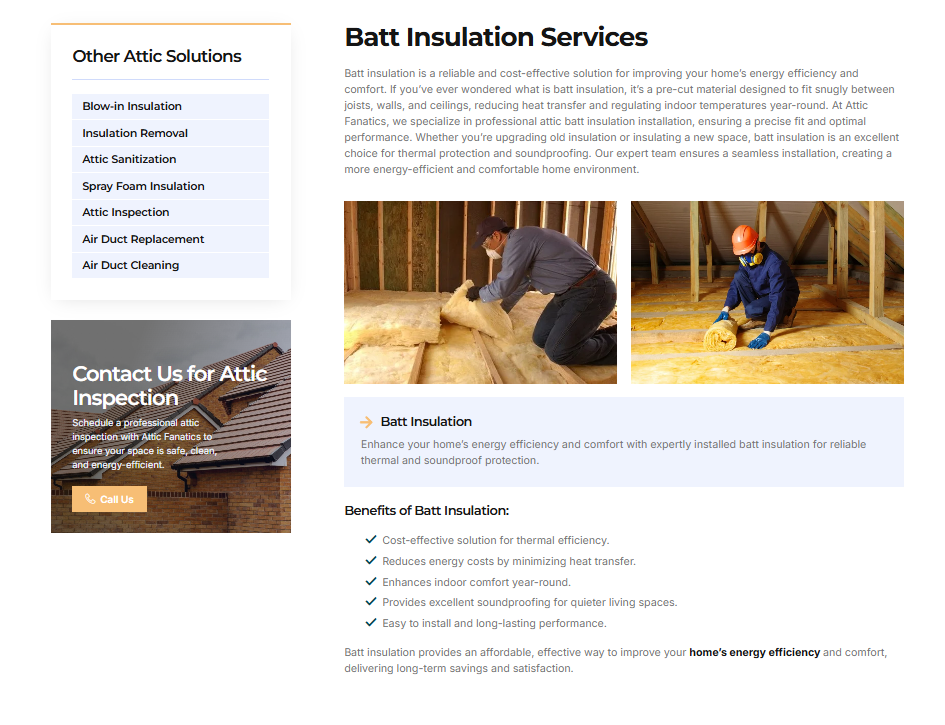
Technical and category pages that did not need to appear in search were intentionally excluded through robots.txt. This helped prevent crawl waste and kept attention on the pages that mattered most for lead generation. The goal was not to index everything. The goal was to make sure the most valuable pages were fully accessible to Google’s crawler.
Publishing Nearly 100 Articles Built Topical Authority
Once the technical foundation was complete, the focus shifted to content production.
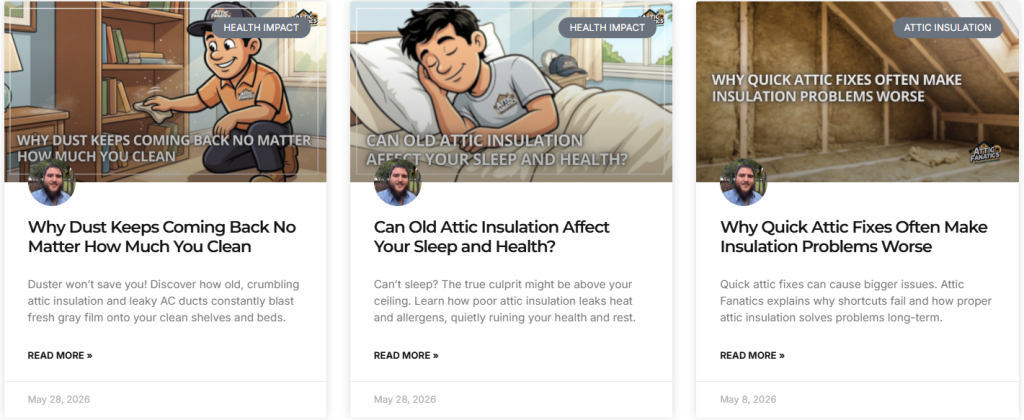
Over the course of a year, nearly 100 informational articles, homeowner guides, and educational resources were published. The goal was never to have a full blog. The goal was to be the most useful resource on the internet for a South Florida homeowner trying to understand why their house will not cool down.
The content covered areas connected to attic insulation, blow-in insulation, spray foam insulation, attic sanitizing, insulation removal, indoor air quality, energy efficiency, and home comfort. This allowed the website to capture informational search intent from people who were still researching their problem before requesting an estimate.
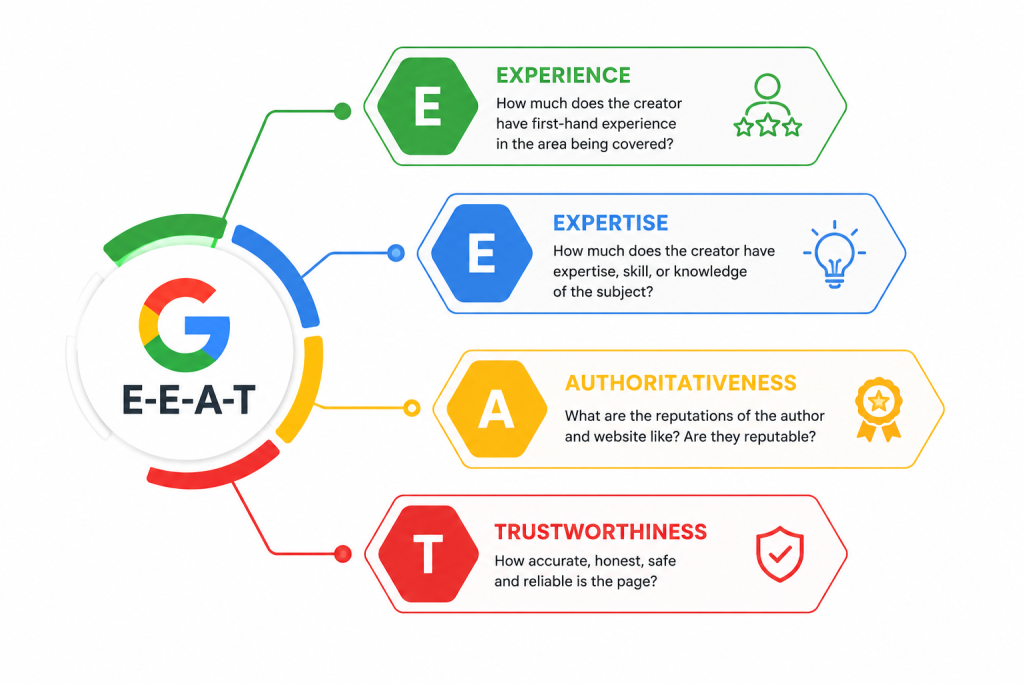
The content strategy also supported E-E-A-T signals.
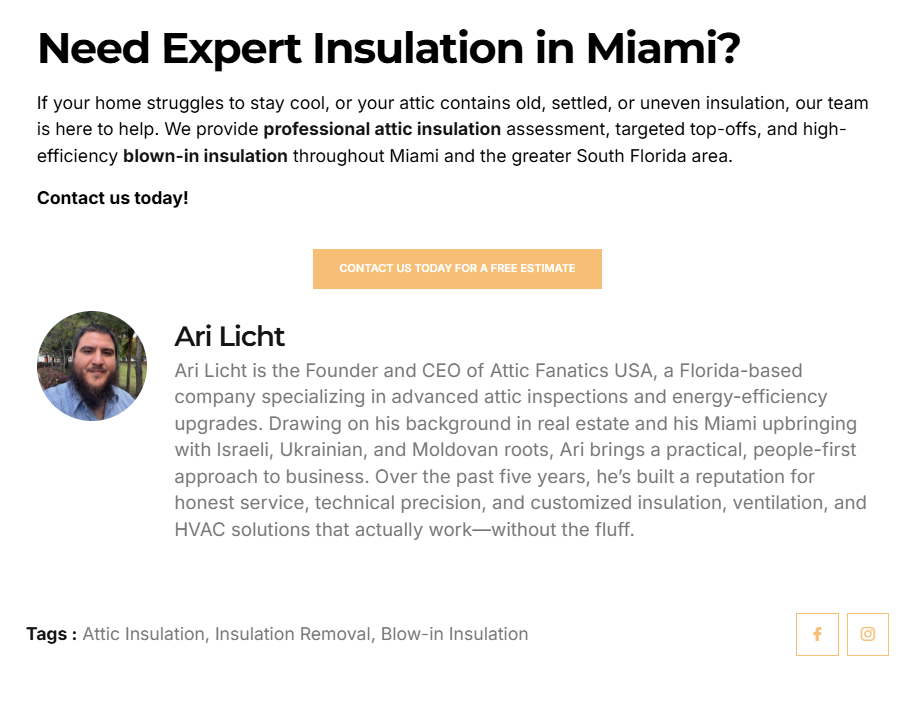
A dedicated author system was developed, making the business owner the primary editor with a complete author profile attached to every article. This helped the content feel more credible and connected to a real expert inside the business, rather than looking like generic SEO content with no clear owner behind it.
Consistent Link Building Strengthened Search Authority
Technical SEO and content were important, but they were not enough on their own. To compete in local search results, the website also needed stronger authority. That is why link building became a year-long strategy. High-quality guest articles and press releases were consistently published on websites with a Domain Rating of 25 and above. The total link-building budget was approximately $4,000.
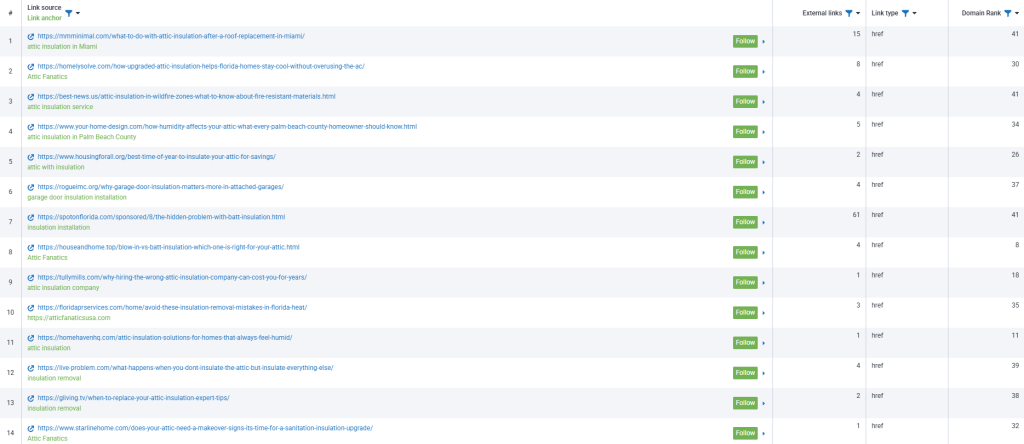
The focus was not on quick wins or risky shortcuts. The goal was to steadily build a natural backlink profile that supported sustainable ranking growth. Each quality link helped strengthen the website’s search authority, making it easier for the improved service pages and educational content to compete in organic search.
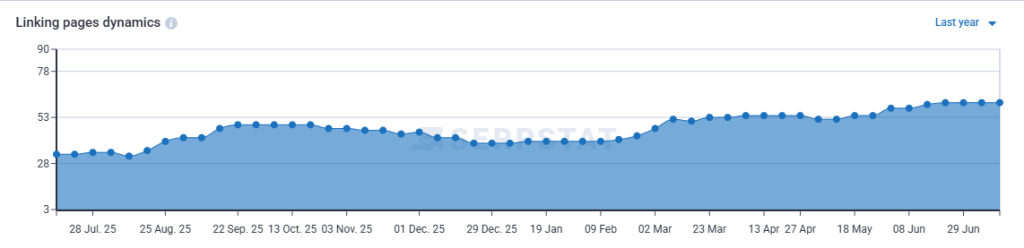
This gave Attic Fanatics a second growth channel alongside Facebook Ads. Paid campaigns continued driving immediate lead flow, while SEO and link building created long-term visibility that could keep producing qualified leads over time.
The Results After One Year of Continuous Optimization
The final results came from the full customer acquisition system, not from one isolated tactic. Facebook advertising created immediate lead volume. Creative testing helped identify the strongest buying triggers. Meta lead forms improved qualification. GHL automation improved speed to lead. The HYPE Sales System helped the team convert opportunities into booked projects. Technical SEO, content marketing, and link building created long-term organic growth.
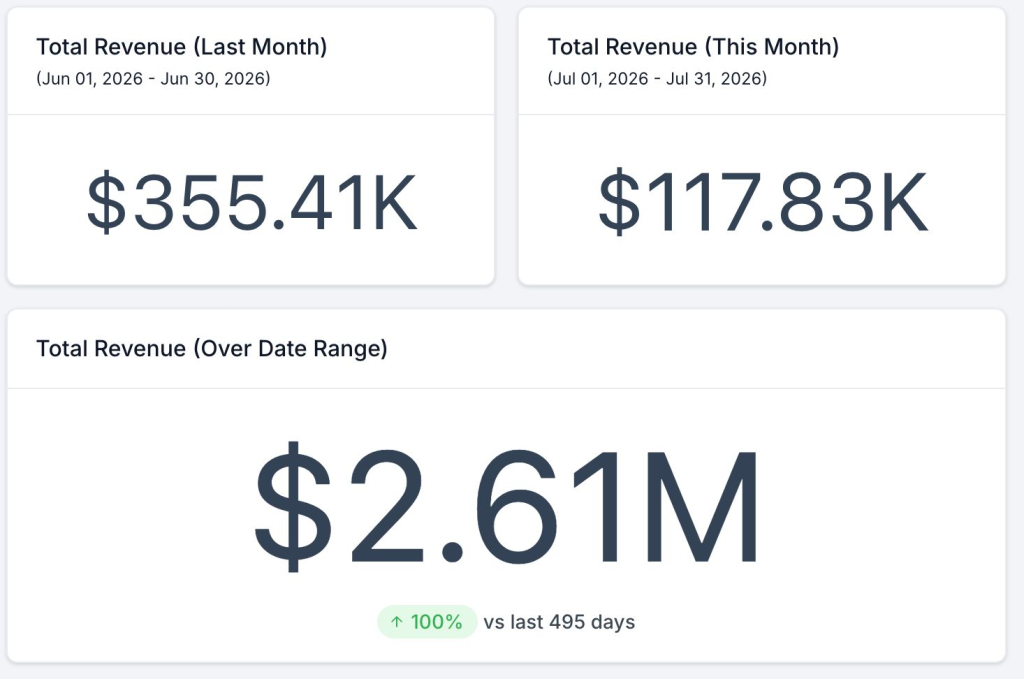
Together, these pieces helped Attic Fanatics generate close to $3 million in revenue. The tracking dashboard showed $355,000+ in revenue in June 2026 alone, $117,000+ in July while the month was still in progress, and $2.61M tracked over the date range. Across the partnership, the account consistently produced strong revenue months and 8x to 12x ROAS across the best-performing campaigns.
| Revenue Metric | Result |
| Total Revenue Generated | Close to $3 Million |
| Facebook Campaigns Launched | 23+ |
| Creative Variations Tested | Hundreds |
| Blog Articles Published | Nearly 100 |
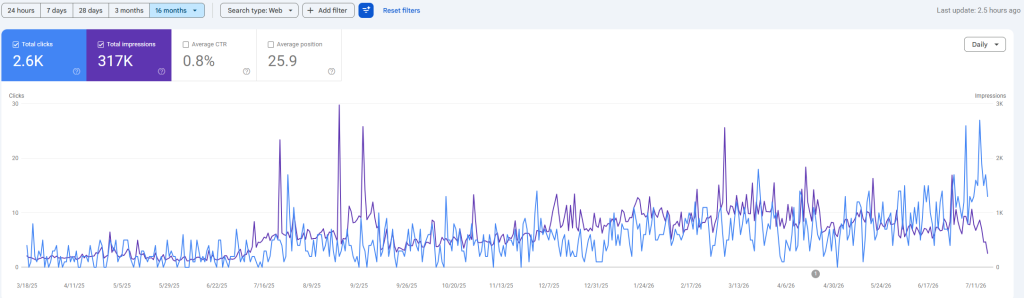
| Organic Leads from SEO | 30–40 qualified leads per month |
| Organic Visibility Growth | Approximately 8–10% month-over-month |
The 30–40 monthly leads came from SEO alone. Facebook Ads continued serving as the company’s primary paid lead generation channel throughout the project, while SEO created a second source of qualified inbound demand.
Here is a snapshot of several major paid campaigns inside the account
| Campaign | Leads | CPL | Spend |
| Savings Main Campaign | 1,627 | $38.32 | $62,342 |
| FOMO Savings | 988 | $35.27 | $34,848 |
| Free Attic Sanitizing | 780 | $28.97 | $22,599 |
| Spanish Speakers | 830 | $25.96 | $21,543 |
| Health / Air Quality | 245 | $37.38 | $9,157 |
| Blow-In Only Campaign | 721 | $28.79 | $20,754 |
| Broad Campaign | 949 | $36.08 | $34,237 |
These numbers are only a glimpse of the account. More angles, campaigns, and creative variations were also working across the full partnership. The important point is that none of these results came from a single advertisement, a single SEO optimization, or one successful campaign. They came from continuously improving every part of the marketing system.
What Made the System Scalable
The system worked because each part supported the next. The ads attracted homeowners through market-specific angles. The lead form qualified people without creating unnecessary friction. The confirmation page created additional inbound calls. GHL automation made sure no lead waited too long. The HYPE Sales System gave the team a process for turning interest into booked work.
SEO optimization added another layer. Technical fixes helped Google crawl and index the right pages. Content built topical authority. Link building strengthened search authority. Organic leads then gave the business another source of qualified traffic outside of paid campaigns. This is why the account could scale beyond one campaign. The growth came from a connected system, not a single tactic.
From Campaigns to Compounding Growth
Sustainable growth does not happen when one campaign performs well. It happens when every stage of the customer journey works toward the same goal. For Attic Fanatics, that meant testing new advertising angles, refining lead qualification, shortening response times, improving the sales process, strengthening technical SEO, publishing authoritative content, and building domain authority through consistent link building.
That is how HYPE Hyperion Digital helped Attic Fanatics generate close to $3 million in revenue. The company did not chase short-term wins. It embraced continuous optimization, and that is what made long-term growth possible.
A sincere thank you to Attic Fanatics for their trust, collaboration, and willingness to continuously test new ideas over the course of the partnership. Close to $3 million in revenue did not come from a single breakthrough. It came from a team that kept showing up, kept testing, and never treated a good month as a reason to stop improving. We are grateful for the opportunity to contribute to their growth and confident in their continued success as both their paid advertising and organic search presence continue to expand.