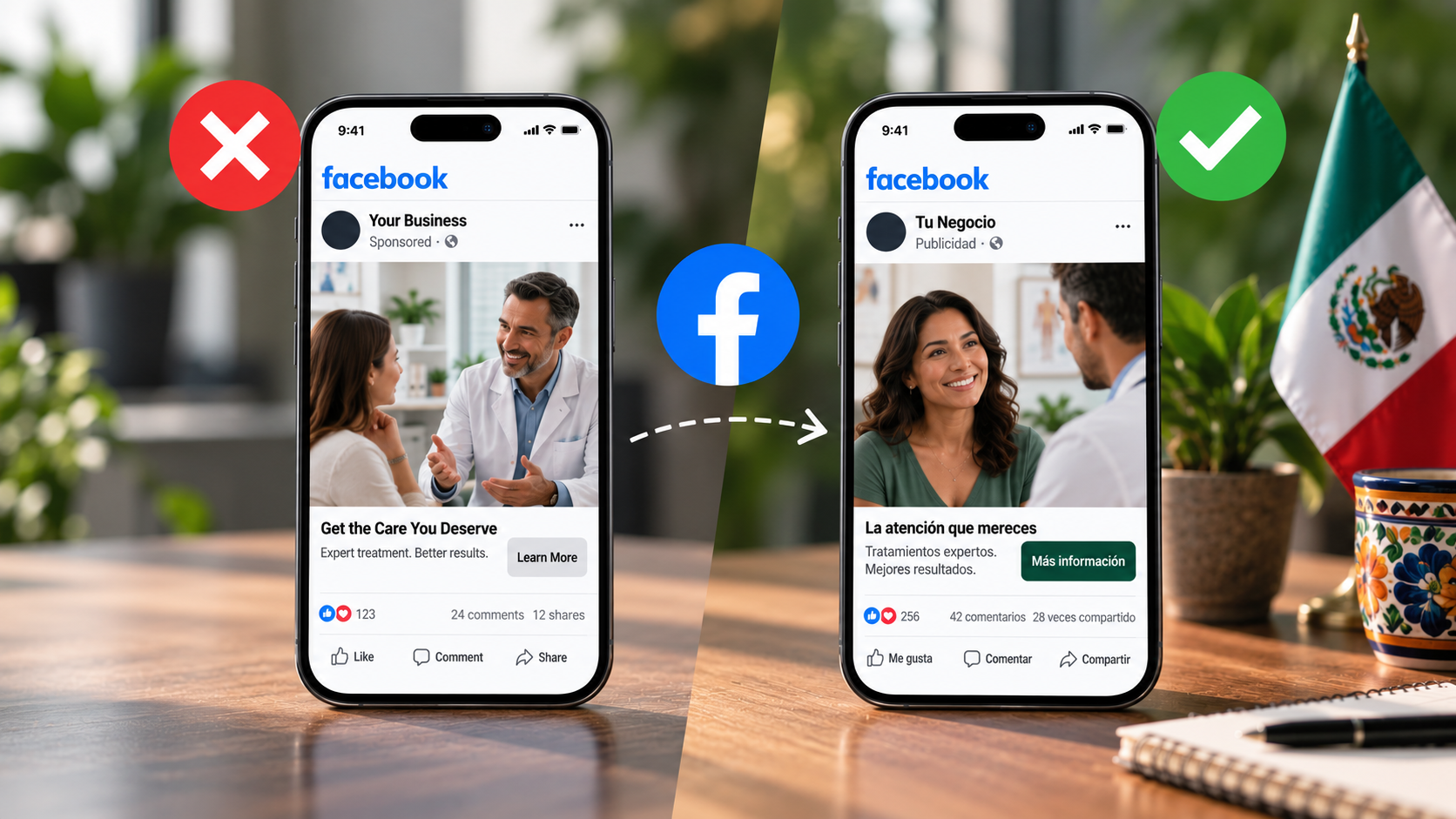
Launching Spanish language Facebook Ads is not as simple as taking an English ad and putting it through Meta’s translation tool. The problem is not that a Spanish-speaking audience converts poorly. The problem is that advertisers often give them a translated English campaign instead of building something specifically for them.
Language is only one part of the equation. The message, emotional angle, creative, visuals, headlines, lead form, and follow-up experience all need to make sense for the people you are trying to reach.
A campaign can technically be in Spanish and still feel like it was built for someone else.
That is why a strong Spanish campaign should be treated as its own strategy, not an English campaign with different words. When the campaign is written natively, built separately, and supported by a business that can actually communicate with Spanish-speaking leads, the entire experience becomes more relevant. That can improve lead generation, Facebook CPL, and ultimately lead quality when the market opportunity is there.
🎯A Spanish Campaign Is Not an English Campaign With Translated Copy
There is a big difference between translation and adaptation. Translation changes the words. Adaptation changes the way the campaign communicates with the audience.
An English campaign was originally built around the language, expectations, emotional triggers, and context of an English-speaking audience. Simply translating the copy does not automatically make the message relevant to a Spanish-speaking audience. The hook might need to change. So might the offer, emotional angle, visual concept, headline, voiceover, lead form, qualification questions, and follow-up experience.
The result is an ad that reads like it was written for someone else, because it was
.
The goal is not to make the English ad “Spanish.” The goal is to make the campaign feel like it was built for the Spanish-speaking audience in the first place.
🧩Before Running Spanish Ads, Make Sure the Business Can Handle Spanish Leads
Before asking whether Meta can target Spanish speakers, there is a more important question:
Can the business actually serve Spanish-speaking customers after they become leads?
Imagine someone sees a Spanish ad, understands the message, fills out a Spanish lead form, and then receives a call from an English-only sales representative. The advertising did its job. The problem happened after the lead came in.
This is where lead quality and follow-up language can get confused. A high-quality Spanish lead can still fail to become a customer if the business cannot communicate with them properly. Spanish-speaking staff should be available for sales, intake, scheduling, or customer service before the campaign launches.
Spanish advertising is not only a marketing decision. It is an operational decision too.
🤖The Meta AI Translation Problem
Meta’s automatic translation can look attractive because it removes a lot of work. You can potentially avoid creating separate copy, developing additional creative, and managing completely separate campaigns for different languages.
On paper, that sounds efficient. The problem is that translation does not automatically create relevance.
📝Literal Translation Is Not Cultural Adaptation
An automated translation can change an English sentence into grammatically correct Spanish without capturing how a Spanish-speaking advertiser would naturally say the same thing.A hook that feels conversational or urgent in English can sound stiff when translated literally. A phrase that creates emotion in one language may lose that effect completely in another.
That is why the goal should not simply be correct Spanish. The copy needs to sound natural, conversational, and appropriate for the audience and service being advertised. Native writing gives the campaign room to preserve the intended emotion instead of simply replacing one set of words with another.
🎨The Visual and the Message Can Stop Matching
Changing the language does not automatically make the creative culturally relevant. The people shown, the setting, the expressions, the situations, and the overall visual story were often chosen for the original audience.
If the text speaks directly to a Spanish-speaking audience but the entire visual concept still feels disconnected from that audience, the campaign can lose some of its relevance. The viewer sees one message in the copy and another message in the creative.
The creative needs to feel like one complete idea, not an English ad with Spanish text placed on top.
📋The Lead Form May Remain in English
The ad and lead form are part of the same conversion experience. If someone clicks a Spanish-language ad and suddenly lands on an English form, the experience becomes inconsistent at exactly the point where you are asking for personal information.
A Spanish campaign should carry the language through the entire form:
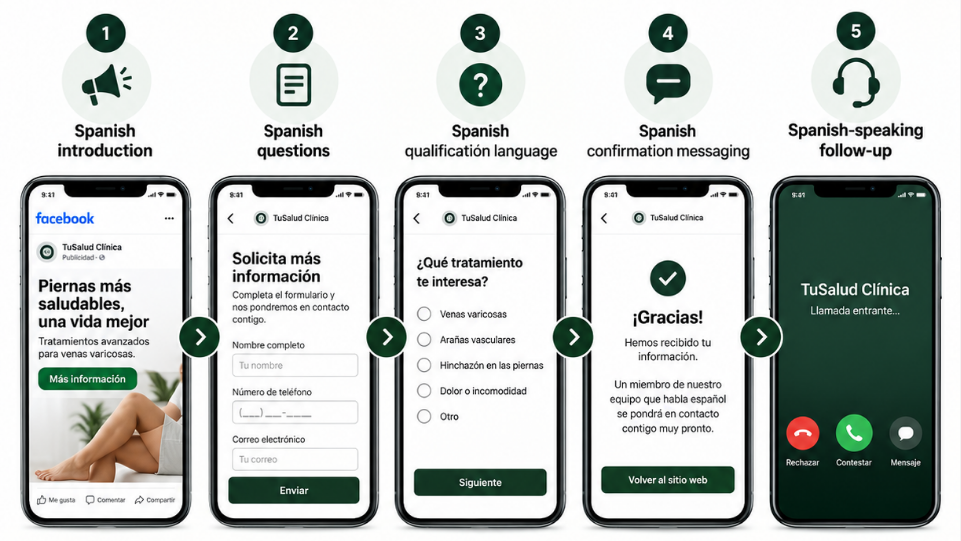
The form is not a technical detail that sits outside the campaign. It is part of the creative experience.
📊Blended Campaign Data Makes Optimization Harder
Running English and Spanish versions together can also make campaign optimization harder. If both audiences and language versions are mixed together, it becomes difficult to understand what is actually driving the results.
You may not know which language is producing the leads, which creative is working with the Spanish-speaking audience, what the actual Spanish CPL is, or whether the Spanish audience is outperforming the English audience at all.
A separate campaign gives you cleaner data and makes the results much easier to read.
🎯You Lose Control Over the Exact Message
This matters even more in industries where people need a high level of trust before taking action. Medical services, home services, insurance, and other high-consideration purchases leave little room for unclear messaging.
You should know exactly what the ad promises and exactly how the service is being described. When machine translation sits between the strategy and the final copy, you introduce another layer that can change the meaning, tone, or emphasis of the message.
🚀What to Do Instead — Build the Spanish Campaign Separately
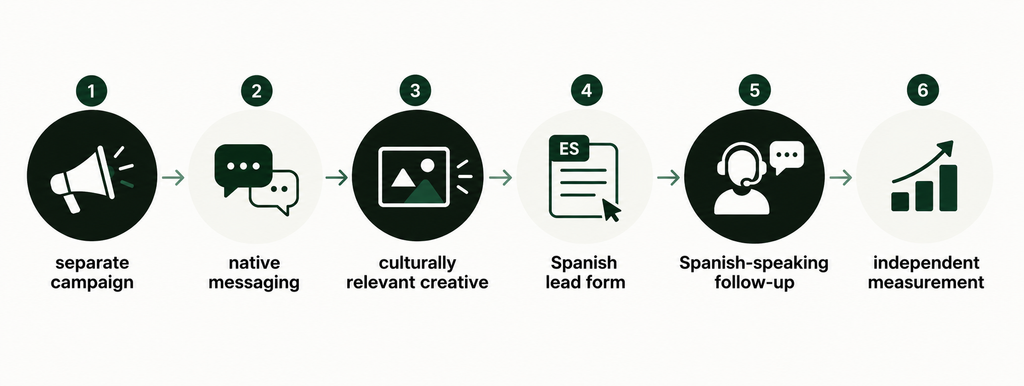
A properly built Spanish campaign should have its own structure rather than being treated as an extension of the English campaign.
That means using:
- 🎯 Separate campaign
- 🧩 Separate ad sets
- 🎨 Separate creative concepts
- ✍️ Separate ad copy
- 📰 Separate headlines
- 🎙️ Native Spanish voiceover where applicable
- 📋 Separate Spanish lead form
- 🤝 Spanish-speaking follow-up team
This is not separation for the sake of making the account more complicated. It gives you three practical advantages: better audience relevance, cleaner performance data, and a consistent Spanish-language experience from the first impression through the sales conversation.
✍️Write the Creative in Spanish From the Start
If the campaign is going to speak to Spanish-speaking customers, the creative should be written for them from the beginning. That means developing the script in Spanish rather than writing an English script first and translating it later.
For video campaigns, the same principle applies to voiceover. A native Spanish voiceover should sound like a natural conversation, not like someone reading a translated English script.
The writing should account for natural phrasing, conversational rhythm, tone, cultural context, emotional triggers, and terminology that actually fits the service category. People can hear the difference between something originally written in their language and something translated into it.
🎨Build Visuals for the Audience, Not Just the Language
Cultural adaptation also applies to the visual side of the campaign. The creative should consider who appears in the image or video, the setting, the situations being shown, emotional expressions, lifestyle context, and the specific concerns that matter to the local community.
For The Vein Place in Santa Ana, the Spanish campaign used natively written copy and culturally appropriate visuals targeting women 35+ in the local Spanish-speaking community.
The reported results were:
- Emotional angle: $14.80 CPL
- Direct symptom angle: $19.61 CPL
- Previous English campaign: $70.74 CPL
Those numbers do not mean every Spanish campaign will automatically outperform an English campaign. They show what can happen when the creative is actually built around the audience instead of simply translated for it.
💡Write New Headlines and Angles
A translated headline is not necessarily the right headline. The broad problem may remain the same, but the way that problem is framed can change.
The campaign can explore different angles around:
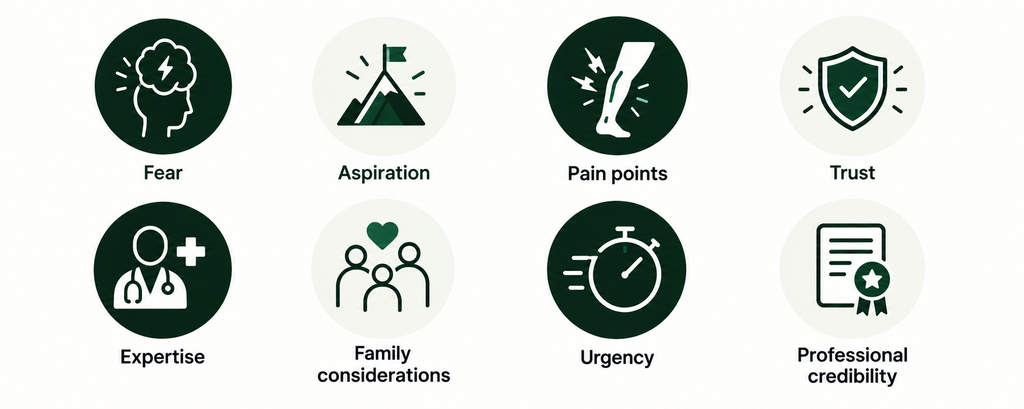
In the Inland Vein & Wound Specialists campaign, one Spanish creative used the headline “Expertos en Venas y Heridas” and focused on clear expertise and a direct service-listing format.
That creative generated 11 leads at a $10.28 CPL within the controlled dynamic creative test. The important point was not simply the language. The concept was developed around what made sense for the audience rather than treating Spanish as a translation layer.
📝Build the Lead Form in Spanish
The lead form should feel like the natural continuation of the ad. If the creative is Spanish but the form suddenly switches back to English, you create unnecessary friction at the exact moment the prospect is deciding whether to submit their information.
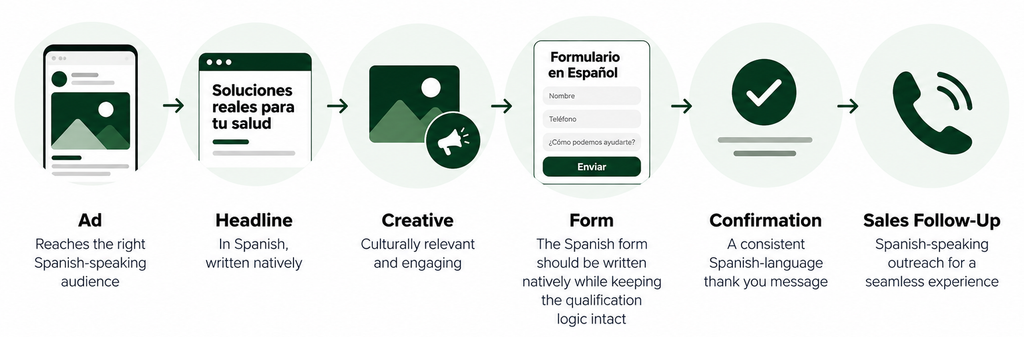
The Spanish form should be written natively while keeping the qualification logic intact. The full experience should feel consistent:
ad → headline → creative → form → confirmation → sales follow-up
That consistency matters because the campaign does not end when someone clicks the ad. The form and follow-up are part of the same conversion path.
📉Why Spanish Campaigns Can Produce Lower CPL
Spanish-speaking audiences do not automatically convert better simply because they speak Spanish. The opportunity often comes from the market around them.
In many local markets, most advertisers still communicate primarily in English. That can leave Spanish-speaking audiences with fewer relevant ads, less creative competition, and less saturation.
When fewer businesses are speaking directly to an audience in its preferred language, a properly built campaign may benefit from:
- 📉 Lower CPM
- 📉 Lower CPL
- 📈 Higher engagement
- 🎯 Stronger audience relevance
- 🧘 Less creative saturation
That does not make a lower CPL guaranteed. It creates an opportunity when an audience is large enough, relevant enough, and underserved enough to justify a dedicated campaign.
📈What the Client Data Shows
Several campaigns give us a useful look at what can happen when Spanish Facebook Advertising is treated as a separate strategy.
🩺The Vein Place — Santa Ana
The Vein Place OC Spanish campaign generated 11 leads at an $18.73 CPL from $206 in spend. The previous English campaign generated 2 leads at a $70.74 CPL from $141 in spend.
Image Ads Examples:
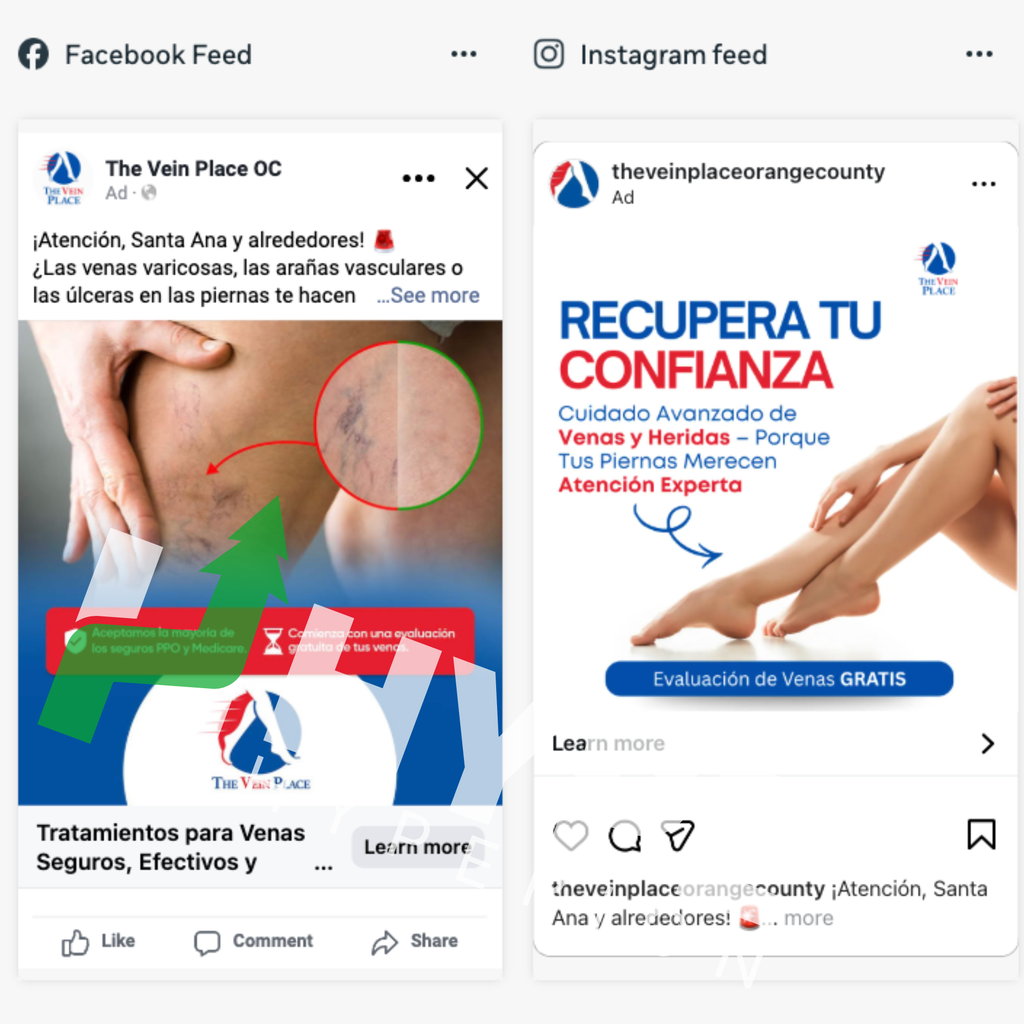
Spanish Video Ad Example:
The difference is significant. The Spanish campaign generated substantially more leads while spending more efficiently.
🩹Inland Vein & Wound Specialists
Inland Vein & Wound Specialists also produced a strong result from its Spanish lead generation campaign. The best-performing ad set reached an $8.70 CPL, reported as the lowest CPL the account had produced since launch.
That result came alongside the “Expertos en Venas y Heridas” creative discussed earlier, showing how a direct, audience-specific concept can perform when it is tested properly.
🏠Attic Fanatics
Attic Fanatics provides another example from a very different service category. Its Spanish campaign generated 830 leads at a $25.96 CPL, making it one of the most efficient campaigns in an account running 10–12 active campaigns simultaneously.
The result demonstrates the potential of a properly structured Spanish campaign even in a competitive advertising environment.
| Client | Spanish Campaign Result | Previous / Context |
|---|---|---|
| The Vein Place | CPL $18.73; 11 leads from $206 | English CPL $70.74; 2 leads from $141 |
| Inland Vein & Wound Specialists | Best ad set: $8.70 CPL | Lowest CPL in account since launch |
| Attic Fanatics | 830 leads at $25.96 CPL | One of the most efficient campaigns among 10–12 active campaigns |
The pattern here is not simply that Spanish converts better. The advantage comes from entering an audience segment where fewer advertisers may be competing with highly relevant creative.
Spanish Is Not the Only Opportunity
The same thinking can apply to other language communities when the market is large enough and underserved enough to support a dedicated campaign.
For example, advertisers could investigate:
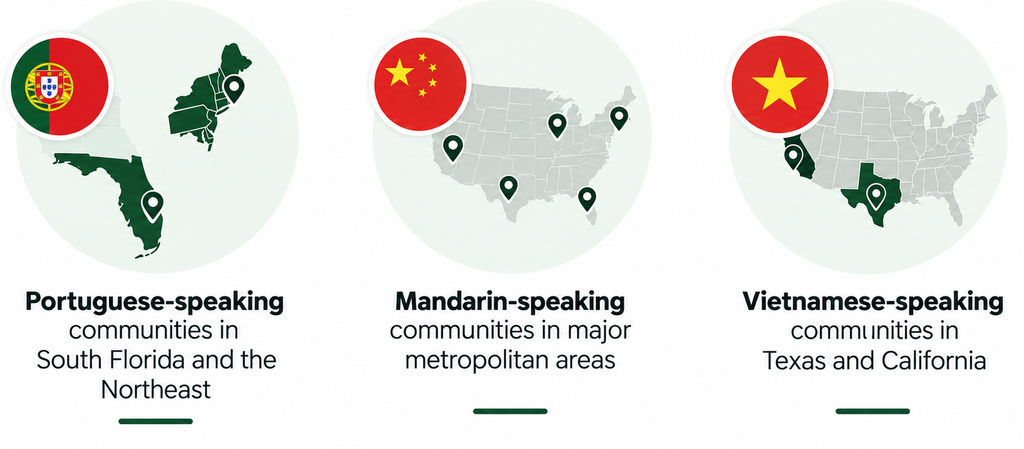
But language alone is not enough to justify a new campaign. Before launching, marketers should look at the size of the language-speaking population, geographic concentration, competition, advertising demand, service category, customer economics, and whether the business actually has native-speaking staff available to handle the leads.
The basic process stays the same:
🧠How to Decide Whether a Spanish Campaign Is Worth Testing
A Spanish campaign can be a strong opportunity, but it should be evaluated like any other marketing investment.
1️⃣Is there a meaningful Spanish-speaking audience in the service area?
The audience needs to be large enough to support a dedicated campaign. A tiny audience may not provide enough room for consistent delivery or meaningful testing.
2️⃣Is the audience underserved by competitors?
Look at what competitors are actually running. If most businesses are communicating in English, there may be an opportunity to build something more relevant for Spanish-speaking customers.
3️⃣ Can the business handle Spanish-speaking leads?
Confirm that Spanish-speaking sales, intake, scheduling, or customer-service support is available. There is little value in generating leads the business cannot properly serve.
4️⃣Is the service relevant to the audience?
Do not assume that every service category needs a Spanish campaign. The audience size and actual demand should justify the investment.
5️⃣ Can the campaign be measured separately?
A dedicated campaign should have its own budget, creative, form, and performance reporting. That makes the actual CPL and lead quality much easier to understand.
6️⃣ Can the business create native-quality creative?
If the company cannot produce natural Spanish copy, voiceover, creative, and follow-up, the campaign may create more problems than opportunities.
Spanish Facebook Advertising is therefore a business and operational decision, not simply a targeting option inside Meta Ads Manager.
⚡Translation Is a Shortcut, Not a Strategy
A translated English ad can technically reach a Spanish-speaking audience. That does not mean the campaign was built for that audience. A stronger approach is to treat Spanish advertising as its own system:
The lower CPL seen across the examples above came alongside several factors: lower competition, less audience saturation, culturally relevant creative, native messaging, consistent language throughout the funnel, and proper follow-up. Spanish itself was not the magic ingredient.
The real opportunity is understanding who the audience is, what matters to them, how they make decisions, and whether the business can deliver the same level of experience after the lead comes in.
Don’t translate the campaign. Rebuild it for the audience.
Language is only the delivery mechanism. The real strategy starts with understanding who you are trying to reach, what matters to them, how they make decisions, and what they need to feel confident enough to take action. Just as importantly, the business needs to be ready to serve those leads once they come in. When the messaging, creative, lead form, follow-up, and customer experience are built around the audience as a whole, Spanish advertising becomes more than a translated campaign. It becomes a genuine growth opportunity.