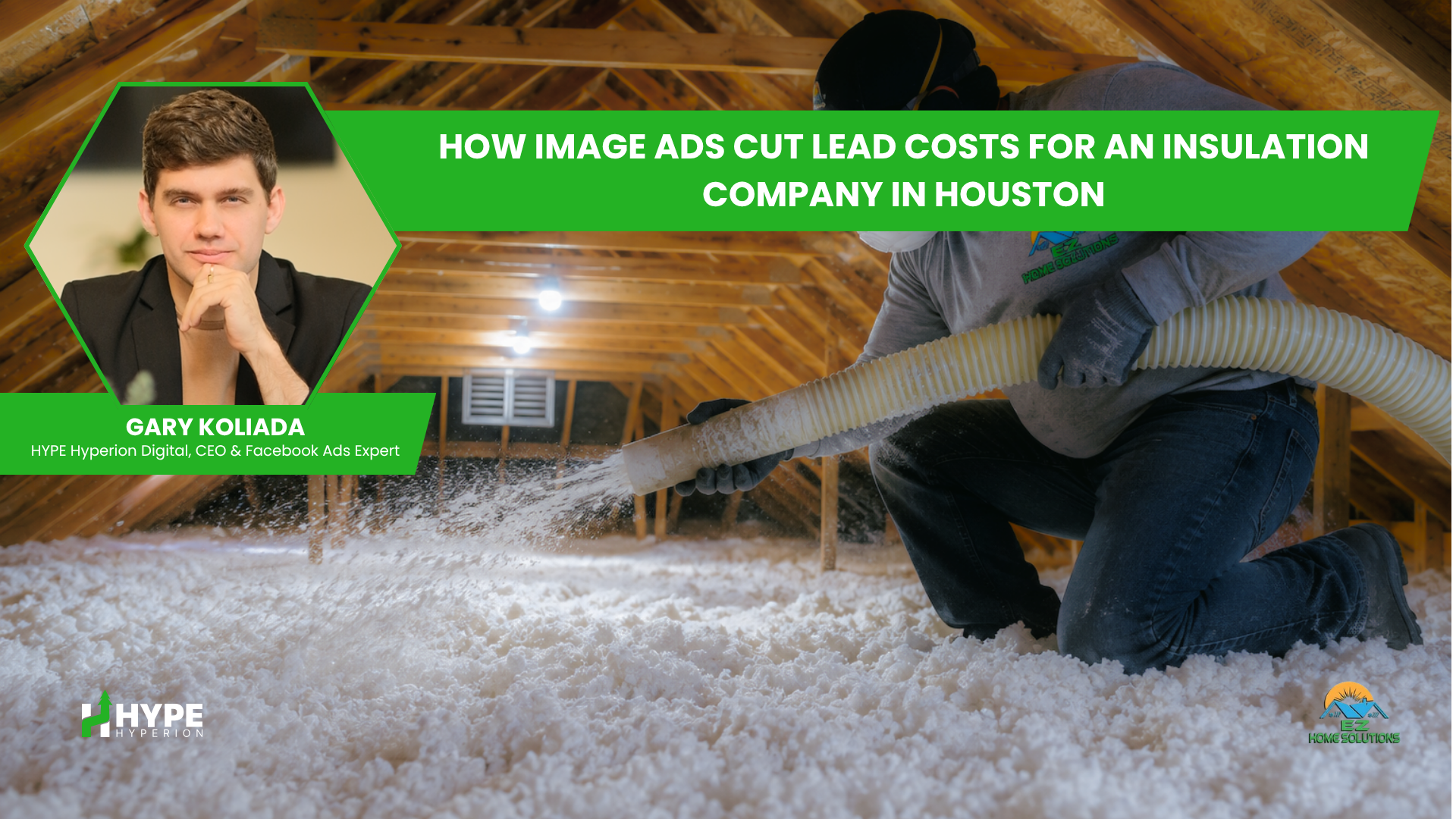
How Image Ads Cut Lead Costs for an Insulation Company in Houston
EZ Home Solutions serves homeowners across Houston with attic insulation, attic cleaning, and rodent proofing.
For this Facebook lead generation campaign, we deliberately took a different approach from the video first strategy that dominates much of home services advertising.
Website: EZ Attic Insulation | Texas Insulation Experts
Instead of assuming video was the only format worth scaling, we launched five image creatives built around different homeowner concerns and let the campaign data decide which messages deserved more budget.
The result was a steady improvement in cost per lead, taking the campaign from a high of $200.13 to $41.45 while generating 187 leads across seven ad sets. The interesting part was not simply that image ads worked. It was why two very specific image concepts eventually emerged as the strongest performers.
Why Image Ads Were Worth Testing in a Video First Market
Video has become almost the default format in home services advertising. It is easy to assume that if competitors are running video, a new campaign needs video to compete. EZ Home Solutions gave us a reason to challenge that assumption.
Instead of immediately investing in video production, we launched five image creatives at the same time. Each one approached the Houston homeowner from a different angle, while the offer remained consistent. The purpose was straightforward: test the message first. If an image could communicate the problem, create enough interest, and give the homeowner a clear reason to act, there was no reason to dismiss the format simply because video was more popular. The campaign therefore tested image ads based on different homeowner motivations rather than producing multiple versions of one generic concept.
Five Creative Angles Put Different Homeowner Concerns to the Test
The campaign tested five distinct creative angles, each built around a different reason why a Houston homeowner might care about their attic.
💬 Testimonial – Used customer proof to build trust and show that other homeowners had already chosen EZ Home Solutions.
😂 Meme – Used a casual, relatable format designed to feel native to the social feed and create a lower barrier to engagement.
🫁 Health Concern – Focused on indoor air quality, bacteria, and concerns about what may be affecting the health of the household.
💰 Savings — Variation 1 Connected attic problems with high energy bills and the ongoing cost of cooling a Houston home.
💵 Savings — Variation 2 Tested another execution of the financial angle to determine whether the savings message could be communicated more effectively.

What Each Angle Was Designed to Do
The purpose of the test was not to decide whether testimonials, memes, health messaging, or savings messaging were universally better.
Each angle was simply a different hypothesis. A homeowner concerned about rising AC bills might respond to savings messaging. Someone worried about the air inside their home might respond to health messaging. Another homeowner might need social proof before taking the first step.
That is why the test focused on different reasons to care, rather than five minor variations of the same ad. The campaign data could then determine which message deserved more attention and budget.
The Campaign Did Not Start at $41 CPL
The campaign did not immediately produce the $41.45 result. The first ad set spent without generating a lead. When leads began coming through, the costs varied significantly from one ad set to another. The highest recorded CPL reached $200.13 on January 8.
From there, the campaign improved through several rounds of optimization. We removed weaker performers, continued testing, and gradually concentrated spend around the combinations producing more efficient results.
Here is the full progression:
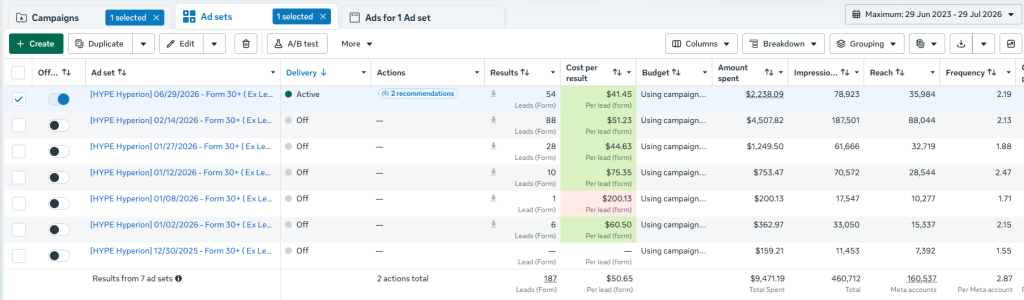
| Ad Set | Leads | CPL | Spend |
| 12/30/2025 | — | — | $159.21 |
| 01/02/2026 | 6 | $60.50 | $362.97 |
| 01/08/2026 | 1 | $200.13 | $200.13 |
| 01/12/2026 | 10 | $75.35 | $753.47 |
| 01/27/2026 | 28 | $44.63 | $1,249.50 |
| 02/14/2026 | 88 | $51.23 | $4,507.82 |
| 06/29/2026 (Active) | 54 | $41.45 | $2,238.09 |
The progression is more important than any individual number. The campaign moved from a $200.13 CPL to $75.35, then to $44.63, and eventually to $41.45 on the active ad set.
Overall, the campaign generated 187 leads from $9,471 in spend. That represents roughly an 80% reduction from the campaign’s highest recorded CPL. The $41.45 result was not created by one sudden change. It came from repeatedly using campaign data to decide what should stay, what should go, and where the next dollar should be spent.
Removing Weak Performers Changed Where the Budget Went
Once enough data accumulated, it became possible to see which ad sets were contributing efficiently and which ones were consuming budget without producing comparable results.
The optimization process became increasingly selective. Rather than allowing every creative and ad set to continue receiving equal attention, weaker performers were removed and budget was progressively concentrated around stronger results. That is where budget allocation became an important part of the campaign strategy and lead generation became more efficient.
The account did not need more ads simply for the sake of having more ads. It needed more of the elements that were already demonstrating a positive signal. The later ad sets show the effect of that approach. The January 27 ad set generated 28 leads at $44.63 CPL. The February 14 ad set generated 88 leads at $51.23 CPL. And the June 29 active ad set reached the campaign’s current low of $41.45 CPL with 54 leads.
The improvement came from several optimization rounds working together, not from one isolated adjustment.
Two Very Different Images Solved the Same Homeowner Problem
After testing five different creative angles, two executions emerged as the strongest performers. They looked very different from each other. One used a real photograph taken inside a contaminated attic. The other used an AI-generated visual showing a cleaner, more polished attic environment. But both were built around the same idea:
Clean Your Attic and Block Rodents
That gave us an interesting creative test. We were not testing two completely different messages. We were testing two different ways of making the same homeowner problem feel real.
Creative 1 — Clean Your Attic and Block Rodents (Real Photo Version)
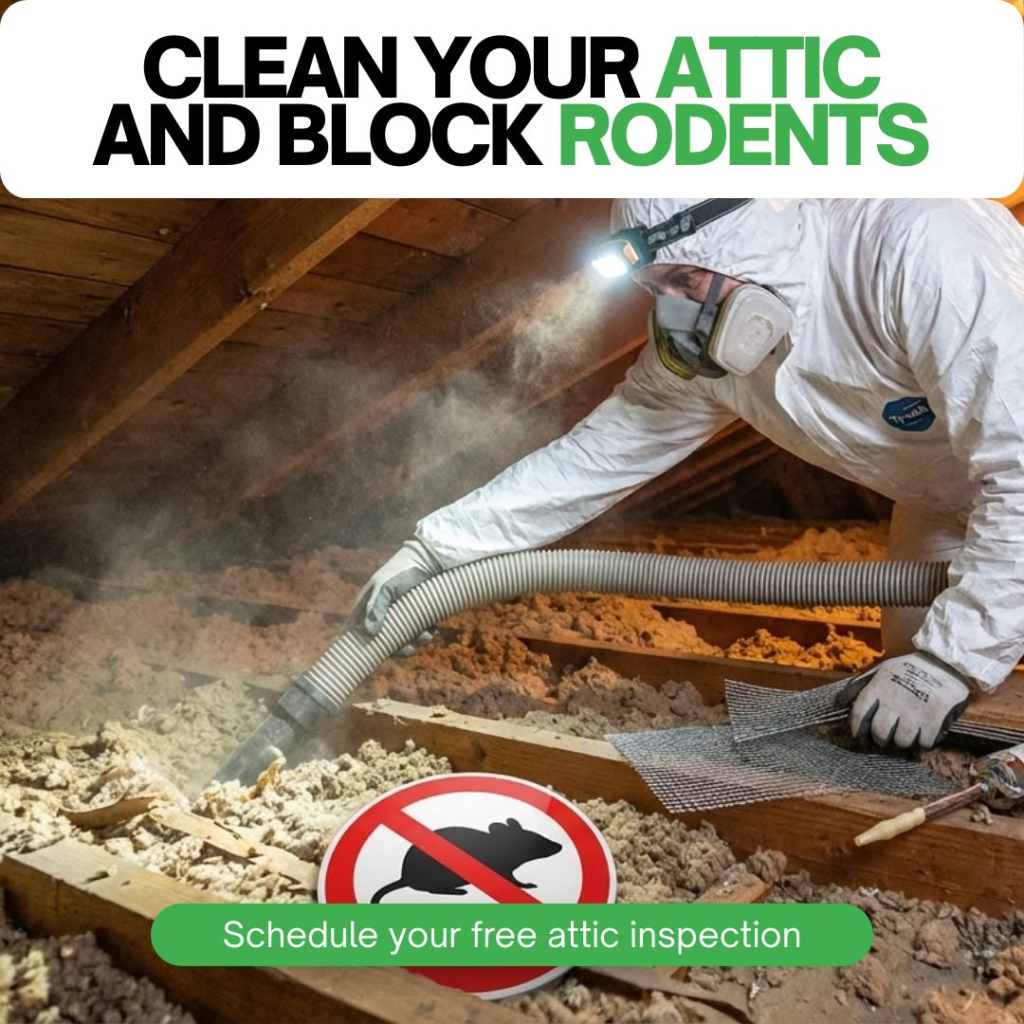
- 📌 Headline: “Clean Your Attic and Block Rodents”
- 📸 Visual: A real photograph of a technician in full protective gear working inside an attic, including a hazmat suit, respirator, headlamp, and equipment being used to remove contaminated insulation.
- 🐀 Supporting visual: A rodent block-out sign is clearly visible in the foreground.
- 👉 CTA: “Schedule your free attic inspection”
- 🏠 Angle: Two related problems, dirty attic conditions and potential rodent entry, addressed through one service.
- 💡 Why it works: The photograph feels immediate and real. Instead of telling homeowners that their attic could be contaminated, it shows them what the environment can actually look like. For someone who has never looked above their ceiling, that visual can make an otherwise invisible problem much easier to understand.
Creative 2 — Clean Your Attic and Block Rodents (AI Visual Version)
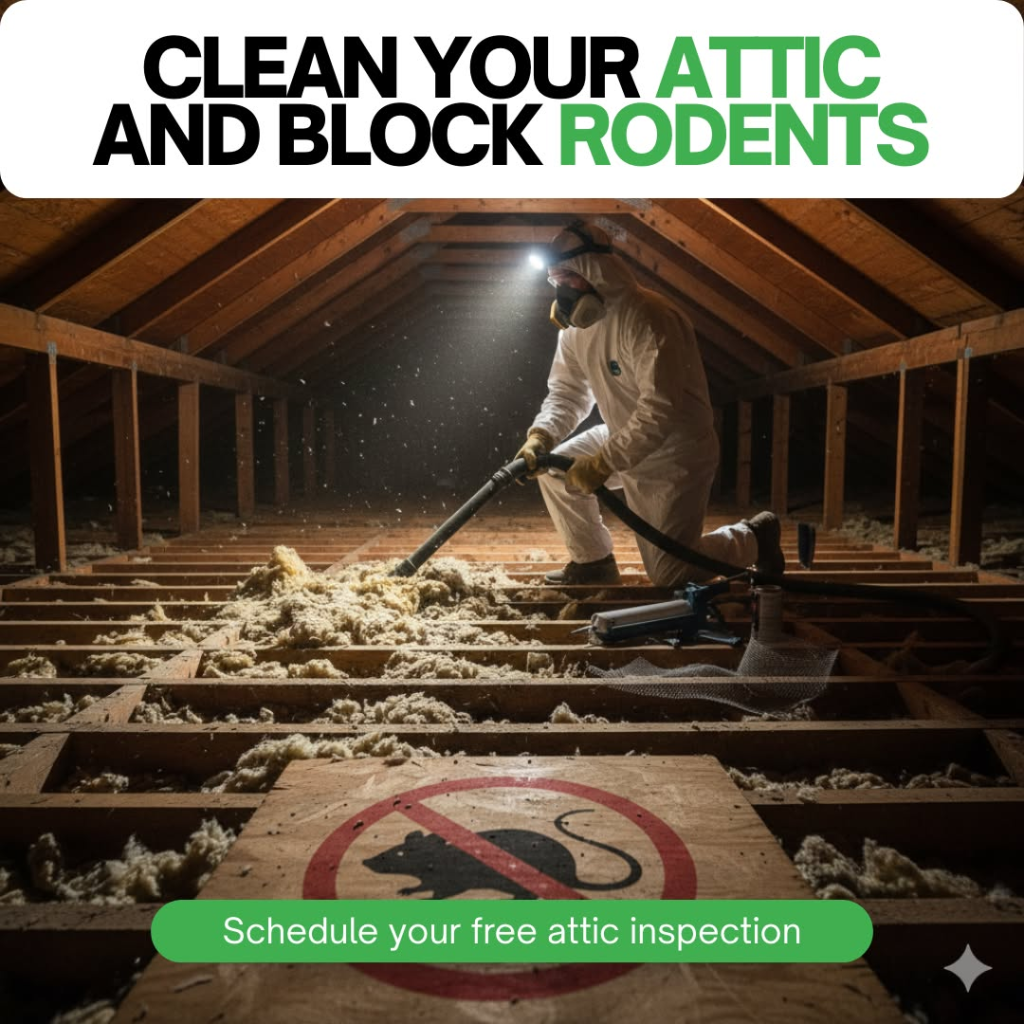
- 📌 Headline: “Clean Your Attic and Block Rodents”
- 👉 CTA: “Schedule your free attic inspection”
- 🖼️ Visual: An AI-generated wide-angle view of a cleaner attic interior with a technician working inside. The rodent block-out sign remains part of the scene.
- 🏠 Angle: The same dual-problem message, presented through a cleaner and more polished visual.
- 💡 Why it works: The real photograph creates urgency by showing the condition of the attic. The AI version puts more emphasis on the result the homeowner wants: a cleaner, treated attic with the rodent issue addressed. It gives the audience a clearer picture of what the finished outcome could look like.
The two executions took different visual approaches, but the underlying message stayed consistent. And that consistency is important because it allowed us to see that the strength of the creative was not coming from the visual style alone. The idea behind the visual was doing much of the work.
Why These 2 Creatives Work — 3 Reasons
1. They Combined Two Problems Homeowners Already Recognize
“Clean your attic” speaks to homeowners who know the space above their ceiling may be neglected, dirty, or in poor condition.
“Block rodents” speaks to a different but closely related concern: scratching sounds, droppings, signs of pests, or the worry that something is getting into the attic. Putting both concerns into one headline gave the creative more reasons to feel relevant without making the message complicated. It still tells the homeowner exactly what the service is about.
2. The Visual Made an Otherwise Invisible Problem Easy to Understand
Most homeowners are not regularly climbing into their attics to check what is happening up there. That creates a challenge for attic advertising. You are asking someone to care about a space they rarely see. The real photograph solved that immediately. A technician working inside a contaminated attic, dressed in protective equipment, communicates the seriousness of the environment before the homeowner even reads the supporting copy. The AI version approached the same problem differently. Rather than focusing as heavily on the condition of the attic, it made the desired outcome easier to picture. So one creative showed why the homeowner should care, while the other helped show what they could get after taking action.
3. Both Creatives Gave the Problem a Clear Next Step
The headline created the reason to pay attention.
The free attic inspection gave the homeowner somewhere to go from there.
That matters because the audience may suspect something is wrong without knowing how serious the problem actually is. Asking them to immediately purchase a service can create unnecessary resistance. A free inspection is a much easier first step.
The creative says, in effect: there may be a problem above your ceiling. Let us take a look. That connection between the problem, the visual, and the CTA made the creative feel like one complete proposition rather than an attention-grabbing image followed by a generic offer.
The Real Photo Made the Problem Impossible to Ignore
The first winning creative used a real photograph of a technician working inside a contaminated attic while wearing full protective equipment. The technician is shown in protective gear, including a respirator and headlamp, while working inside the attic with equipment used to remove contaminated insulation. A rodent block out sign is also visible in the foreground.
🧹 The headline was direct: “Clean Your Attic and Block Rodents”
👉 The CTA: “Schedule your free attic inspection.”
The strength of the image was that it showed homeowners something they normally never see. Most people do not regularly inspect the space above their ceiling. They may know an attic exists, but they have little idea what condition it is actually in.
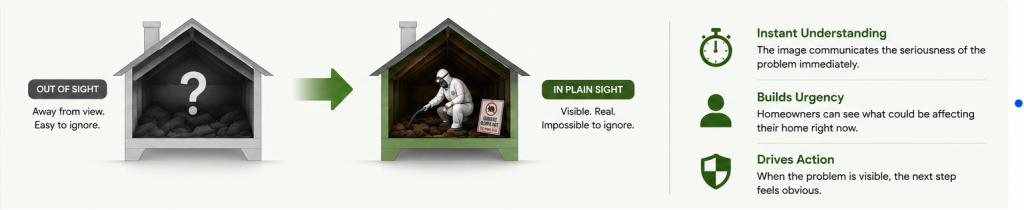
The photograph removes that uncertainty. Instead of explaining contamination through several lines of copy, the image shows a professional working in the environment while wearing protective equipment. The visual itself communicates that this is more than a routine cleaning job. That made the homeowner pain point tangible without needing a long explanation.
The AI Visual Focused More on the Outcome
The second winning creative used an AI-generated visual to communicate the same core idea through a different presentation. It retained the same “Clean Your Attic and Block Rodents” headline and CTA, while showing a cleaner, more polished attic environment with a technician working inside. The rodent block-out sign remained part of the scene.
The visual effect was different from the real photograph. The real image creates urgency by showing the condition of the attic as it is. The AI visual puts more emphasis on the result the homeowner wants: a cleaner, treated attic that is also protected against rodent entry.
The two creatives were not competing ideas. They were two different ways of presenting the same message. The real photo made the problem feel more immediate, while the AI version made the outcome easier to picture.
Why “Clean Your Attic and Block Rodents” Was Stronger Than a Single Problem Message
The strongest creative insight was not simply the image. It was the decision to connect two recognizable attic problems in one headline.
| Single Problem Message | Combined Message |
| Focuses on one homeowner concern | Addresses attic cleanliness and rodent entry |
| Relevant to a narrower group | Relevant to homeowners concerned about either problem |
| One reason to investigate the attic | Two recognizable reasons to take action |
| Can feel like a routine service | Creates a stronger sense of overall attic protection |
“Clean your attic” speaks to homeowners who know the space above their ceiling may be neglected or contaminated. “Block rodents” speaks to people who have heard scratching, noticed droppings, or simply do not want pests getting into their home.
Putting both together made the message relevant to more homeowners without making it vague. The headline still tells you exactly what the service is about, but it gives the audience more than one reason to care.
That was the real strength of the creative: two familiar problems, one simple message, and one clear next step.
The Image Made an Invisible Home Problem Visible
Most homeowners rarely inspect the inside of their attic, so they have little idea what is actually happening above the ceiling. That creates a challenge for attic services because the problem is out of sight, even when it may be affecting the home. The real photograph solved that immediately by showing a technician in full protective gear working inside a contaminated attic. Seeing the respirator, protective clothing, equipment, and condition of the space made the problem feel real without needing a long explanation.
That is where strong visual communication can make a difference. Instead of telling homeowners that their attic may have a problem, the image showed them what that problem could look like. It turned an otherwise invisible homeowner pain point into something they could understand in seconds. From a creative strategy perspective, that was important because the image did the explaining before the homeowner even had to read the rest of the ad.
The Free Inspection Removed the Final Barrier to Action
The free attic inspection worked because it gave homeowners a simple next step without asking them to commit to a paid service. Someone might suspect there is a problem above the ceiling but still hesitate to request an inspection if they think it will immediately lead to a sales conversation or a service bill. With a free inspection, they could find out what was actually happening before making that decision. There was no price to approve, no contract to sign, and no pressure to move forward.
That made the CTA a natural part of the creative rather than a generic offer added at the end. The image showed homeowners why they might need to look inside their attic, while the free inspection gave them an easy way to find out what was really going on.
What the EZ Home Solutions Campaign Proved About Image Ads
This campaign does not mean image ads will always outperform video. It shows that the format alone does not decide campaign performance. In this case, the combination of a clear homeowner problem, a relevant visual, a specific message, and a simple CTA was enough to bring CPL down to a stable $41.45 without relying on video production.
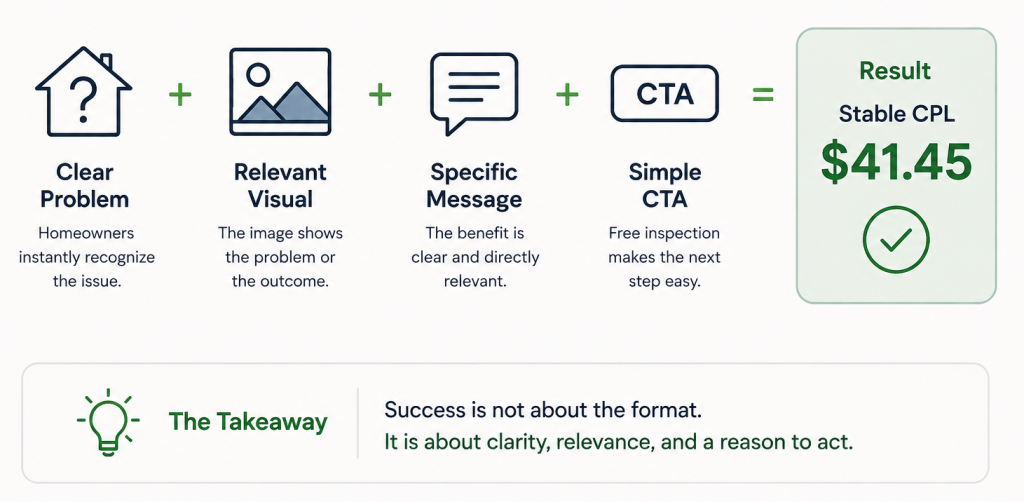
The two strongest ads made the problem easy to understand in a single image. One showed the real condition of the attic, while the other focused more on the cleaner outcome. Both gave homeowners a clear reason to care and an easy next step through the free inspection.
That is the bigger lesson for meta advertising. Instead of assuming video is the better option because it is more popular, the right image creative should get the same chance to prove itself. What matters is whether the creative makes the problem clear, connects with the right audience, and gives them a reason to act. For EZ Home Solutions, the data showed that a well-tested image could do exactly that.
What We Would Take Into the Next Home Services Campaign
The EZ Home Solutions campaign reinforced a simple approach: test different homeowner motivations, keep the offer consistent, give the campaign enough data to reveal meaningful patterns, and move budget toward what is actually working. Most importantly, don’t assume video is always the answer. Let the audience response and campaign data decide which creative deserves more budget.
For EZ Home Solutions, that meant taking the campaign from a $200.13 CPL to a stable $41.45, with 187 leads generated along the way.